@vonzhou
2016-08-24T13:45:18.000000Z
字数 15318
阅读 243
DispatcherServlet 源码阅读(1)
博客
有时间还是应该多看看源码。
DispatcherServlet 是一个实实在在的 Servlet,所以 Spring MVC 引入后不会改变 Servlet 容器的行为,仍然是解析 web.xml 部署文件,只需要在里面配置这个 Servlet 即可。
比如下面配置 dispatcher Servlet 处理所有的请求,也体现了 DispatcherServlet 是前端控制器(Front Controller)。contextConfigLocation 上下文参数用于配置路径的指定,如果没有的话就使用默认的值。
<?xml version="1.0" encoding="UTF-8"?><web-app xmlns="http://java.sun.com/xml/ns/javaee"xmlns:xsi="http://www.w3.org/2001/XMLSchema-instance"xsi:schemaLocation="http://java.sun.com/xml/ns/javaee http://java.sun.com/xml/ns/javaee/web-app_3_0.xsd"version="3.0"><servlet><servlet-name>dispatcher</servlet-name><servlet-class>org.springframework.web.servlet.DispatcherServlet</servlet-class><load-on-startup>1</load-on-startup></servlet><servlet-mapping><servlet-name>dispatcher</servlet-name><url-pattern>/</url-pattern></servlet-mapping><listener><listener-class>org.springframework.web.context.ContextLoaderListener</listener-class></listener><context-param><param-name>contextConfigLocation</param-name><param-value>/WEB-INF/dispatcher-servlet.xmlclasspath:service-context.xml</param-value></context-param></web-app>
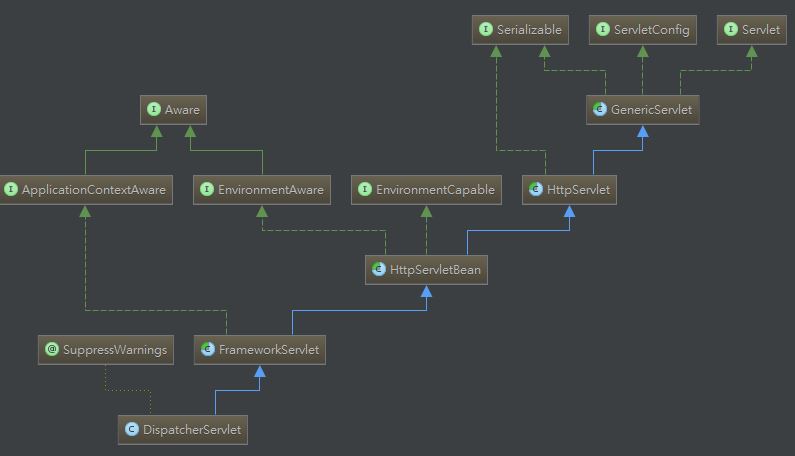
DispatcherServlet 初始化
DispatcherServlet 的父类 HttpServletBean 覆盖了 HttpServlet 的 init 方法,实现该 servlet 的初始化。
/*** Map config parameters onto bean properties of this servlet, and* invoke subclass initialization.* @throws ServletException if bean properties are invalid (or required* properties are missing), or if subclass initialization fails.*/@Overridepublic final void init() throws ServletException {if (logger.isDebugEnabled()) {logger.debug("Initializing servlet '" + getServletName() + "'");}// Set bean properties from init parameters.try {PropertyValues pvs = new ServletConfigPropertyValues(getServletConfig(), this.requiredProperties);BeanWrapper bw = PropertyAccessorFactory.forBeanPropertyAccess(this);ResourceLoader resourceLoader = new ServletContextResourceLoader(getServletContext());bw.registerCustomEditor(Resource.class, new ResourceEditor(resourceLoader, getEnvironment()));initBeanWrapper(bw);bw.setPropertyValues(pvs, true);}catch (BeansException ex) {logger.error("Failed to set bean properties on servlet '" + getServletName() + "'", ex);throw ex;}// Let subclasses do whatever initialization they like.initServletBean();if (logger.isDebugEnabled()) {logger.debug("Servlet '" + getServletName() + "' configured successfully");}}
正如注释所说 initServletBean() 留由子类实现,体现了模板方法模式,当上述bean属性设置完成后,进入这里 FrameworkServlet#init() 创建 Servlet 的上下文 WebApplicationContext,initWebApplicationContext 首先会获得该 Web 应用的 root WebApplicationContext (通常是由 org.springframework.web.context.ContextLoaderListener 加载的),然后根据这个根上下文得到我们这个 Servlet 的 WebApplicationContext。initFrameworkServlet 方法是空的,而且子类 DispatcherServlet 也没有覆盖。
/*** Overridden method of {@link HttpServletBean}, invoked after any bean properties* have been set. Creates this servlet's WebApplicationContext.*/@Overrideprotected final void initServletBean() throws ServletException {getServletContext().log("Initializing Spring FrameworkServlet '" + getServletName() + "'");if (this.logger.isInfoEnabled()) {this.logger.info("FrameworkServlet '" + getServletName() + "': initialization started");}long startTime = System.currentTimeMillis();try {this.webApplicationContext = initWebApplicationContext();initFrameworkServlet();}catch (ServletException ex) {this.logger.error("Context initialization failed", ex);throw ex;}catch (RuntimeException ex) {this.logger.error("Context initialization failed", ex);throw ex;}if (this.logger.isInfoEnabled()) {long elapsedTime = System.currentTimeMillis() - startTime;this.logger.info("FrameworkServlet '" + getServletName() + "': initialization completed in " +elapsedTime + " ms");}}/*** Initialize and publish the WebApplicationContext for this servlet.* <p>Delegates to {@link #createWebApplicationContext} for actual creation* of the context. Can be overridden in subclasses.* @return the WebApplicationContext instance* @see #FrameworkServlet(WebApplicationContext)* @see #setContextClass* @see #setContextConfigLocation*/protected WebApplicationContext initWebApplicationContext() {WebApplicationContext rootContext =WebApplicationContextUtils.getWebApplicationContext(getServletContext());WebApplicationContext wac = null;if (this.webApplicationContext != null) {// A context instance was injected at construction time -> use itwac = this.webApplicationContext;if (wac instanceof ConfigurableWebApplicationContext) {ConfigurableWebApplicationContext cwac = (ConfigurableWebApplicationContext) wac;if (!cwac.isActive()) {// The context has not yet been refreshed -> provide services such as// setting the parent context, setting the application context id, etcif (cwac.getParent() == null) {// The context instance was injected without an explicit parent -> set// the root application context (if any; may be null) as the parentcwac.setParent(rootContext);}configureAndRefreshWebApplicationContext(cwac);}}}if (wac == null) {// No context instance was injected at construction time -> see if one// has been registered in the servlet context. If one exists, it is assumed// that the parent context (if any) has already been set and that the// user has performed any initialization such as setting the context idwac = findWebApplicationContext();}if (wac == null) {// No context instance is defined for this servlet -> create a local onewac = createWebApplicationContext(rootContext);}if (!this.refreshEventReceived) {// Either the context is not a ConfigurableApplicationContext with refresh// support or the context injected at construction time had already been// refreshed -> trigger initial onRefresh manually here.onRefresh(wac);}if (this.publishContext) {// Publish the context as a servlet context attribute.String attrName = getServletContextAttributeName();getServletContext().setAttribute(attrName, wac);if (this.logger.isDebugEnabled()) {this.logger.debug("Published WebApplicationContext of servlet '" + getServletName() +"' as ServletContext attribute with name [" + attrName + "]");}}return wac;}
DispatcherServlet 处理请求流程
FrameworkServlet 中覆盖了 HttpServlet 的 doGet(),doPost()等方法,而 doGet(),doPost()等又直接调用方法 processRequest 来处理请求,代码如下。
/*** Delegate GET requests to processRequest/doService.* <p>Will also be invoked by HttpServlet's default implementation of {@code doHead},* with a {@code NoBodyResponse} that just captures the content length.* @see #doService* @see #doHead*/@Overrideprotected final void doGet(HttpServletRequest request, HttpServletResponse response)throws ServletException, IOException {processRequest(request, response);}/*** Delegate POST requests to {@link #processRequest}.* @see #doService*/@Overrideprotected final void doPost(HttpServletRequest request, HttpServletResponse response)throws ServletException, IOException {processRequest(request, response);}
然后我们进入 processRequest 方法,实际的请求处理是调用其抽象方法 doService。
/*** Process this request, publishing an event regardless of the outcome.* <p>The actual event handling is performed by the abstract* {@link #doService} template method.*/protected final void processRequest(HttpServletRequest request, HttpServletResponse response)throws ServletException, IOException {long startTime = System.currentTimeMillis();Throwable failureCause = null;LocaleContext previousLocaleContext = LocaleContextHolder.getLocaleContext();LocaleContext localeContext = buildLocaleContext(request);RequestAttributes previousAttributes = RequestContextHolder.getRequestAttributes();ServletRequestAttributes requestAttributes = buildRequestAttributes(request, response, previousAttributes);WebAsyncManager asyncManager = WebAsyncUtils.getAsyncManager(request);asyncManager.registerCallableInterceptor(FrameworkServlet.class.getName(), new RequestBindingInterceptor());initContextHolders(request, localeContext, requestAttributes);try {doService(request, response);}catch (ServletException ex) {failureCause = ex;throw ex;}catch (IOException ex) {failureCause = ex;throw ex;}catch (Throwable ex) {failureCause = ex;throw new NestedServletException("Request processing failed", ex);}finally {resetContextHolders(request, previousLocaleContext, previousAttributes);if (requestAttributes != null) {requestAttributes.requestCompleted();}if (logger.isDebugEnabled()) {if (failureCause != null) {this.logger.debug("Could not complete request", failureCause);}else {if (asyncManager.isConcurrentHandlingStarted()) {logger.debug("Leaving response open for concurrent processing");}else {this.logger.debug("Successfully completed request");}}}publishRequestHandledEvent(request, response, startTime, failureCause);}}/*** Subclasses must implement this method to do the work of request handling,* receiving a centralized callback for GET, POST, PUT and DELETE.* <p>The contract is essentially the same as that for the commonly overridden* {@code doGet} or {@code doPost} methods of HttpServlet.* <p>This class intercepts calls to ensure that exception handling and* event publication takes place.* @param request current HTTP request* @param response current HTTP response* @throws Exception in case of any kind of processing failure* @see javax.servlet.http.HttpServlet#doGet* @see javax.servlet.http.HttpServlet#doPost*/protected abstract void doService(HttpServletRequest request, HttpServletResponse response)throws Exception;
然后在 DispatcherServlet 中具体实现请求的处理分发,先是把一些资源放到请求属性中,然后调用 doDispatch 实现请求分发到控制器的 handler。doDispatch 中首先会判断是否是文件传输流的请求(利用MultipartResolver),如果是的话就会转为 MultipartHttpServletRequest。接下来 getHandler(processedRequest) 根据请求获得对应的handler,最后调用 handle() 处理请求,会反射到在控制器中实现的方法。
/*** Exposes the DispatcherServlet-specific request attributes and delegates to {@link #doDispatch}* for the actual dispatching.*/@Overrideprotected void doService(HttpServletRequest request, HttpServletResponse response) throws Exception {if (logger.isDebugEnabled()) {String resumed = WebAsyncUtils.getAsyncManager(request).hasConcurrentResult() ? " resumed" : "";logger.debug("DispatcherServlet with name '" + getServletName() + "'" + resumed +" processing " + request.getMethod() + " request for [" + getRequestUri(request) + "]");}// Keep a snapshot of the request attributes in case of an include,// to be able to restore the original attributes after the include.Map<String, Object> attributesSnapshot = null;if (WebUtils.isIncludeRequest(request)) {attributesSnapshot = new HashMap<String, Object>();Enumeration<?> attrNames = request.getAttributeNames();while (attrNames.hasMoreElements()) {String attrName = (String) attrNames.nextElement();if (this.cleanupAfterInclude || attrName.startsWith("org.springframework.web.servlet")) {attributesSnapshot.put(attrName, request.getAttribute(attrName));}}}// Make framework objects available to handlers and view objects.request.setAttribute(WEB_APPLICATION_CONTEXT_ATTRIBUTE, getWebApplicationContext());request.setAttribute(LOCALE_RESOLVER_ATTRIBUTE, this.localeResolver);request.setAttribute(THEME_RESOLVER_ATTRIBUTE, this.themeResolver);request.setAttribute(THEME_SOURCE_ATTRIBUTE, getThemeSource());FlashMap inputFlashMap = this.flashMapManager.retrieveAndUpdate(request, response);if (inputFlashMap != null) {request.setAttribute(INPUT_FLASH_MAP_ATTRIBUTE, Collections.unmodifiableMap(inputFlashMap));}request.setAttribute(OUTPUT_FLASH_MAP_ATTRIBUTE, new FlashMap());request.setAttribute(FLASH_MAP_MANAGER_ATTRIBUTE, this.flashMapManager);try {doDispatch(request, response);}finally {if (!WebAsyncUtils.getAsyncManager(request).isConcurrentHandlingStarted()) {// Restore the original attribute snapshot, in case of an include.if (attributesSnapshot != null) {restoreAttributesAfterInclude(request, attributesSnapshot);}}}}/*** Process the actual dispatching to the handler.* <p>The handler will be obtained by applying the servlet's HandlerMappings in order.* The HandlerAdapter will be obtained by querying the servlet's installed HandlerAdapters* to find the first that supports the handler class.* <p>All HTTP methods are handled by this method. It's up to HandlerAdapters or handlers* themselves to decide which methods are acceptable.* @param request current HTTP request* @param response current HTTP response* @throws Exception in case of any kind of processing failure*/protected void doDispatch(HttpServletRequest request, HttpServletResponse response) throws Exception {HttpServletRequest processedRequest = request;HandlerExecutionChain mappedHandler = null;boolean multipartRequestParsed = false;WebAsyncManager asyncManager = WebAsyncUtils.getAsyncManager(request);try {ModelAndView mv = null;Exception dispatchException = null;try {processedRequest = checkMultipart(request);multipartRequestParsed = (processedRequest != request);// Determine handler for the current request.mappedHandler = getHandler(processedRequest);if (mappedHandler == null || mappedHandler.getHandler() == null) {noHandlerFound(processedRequest, response);return;}// Determine handler adapter for the current request.HandlerAdapter ha = getHandlerAdapter(mappedHandler.getHandler());// Process last-modified header, if supported by the handler.String method = request.getMethod();boolean isGet = "GET".equals(method);if (isGet || "HEAD".equals(method)) {long lastModified = ha.getLastModified(request, mappedHandler.getHandler());if (logger.isDebugEnabled()) {logger.debug("Last-Modified value for [" + getRequestUri(request) + "] is: " + lastModified);}if (new ServletWebRequest(request, response).checkNotModified(lastModified) && isGet) {return;}}if (!mappedHandler.applyPreHandle(processedRequest, response)) {return;}// Actually invoke the handler.mv = ha.handle(processedRequest, response, mappedHandler.getHandler());if (asyncManager.isConcurrentHandlingStarted()) {return;}applyDefaultViewName(processedRequest, mv);mappedHandler.applyPostHandle(processedRequest, response, mv);}catch (Exception ex) {dispatchException = ex;}processDispatchResult(processedRequest, response, mappedHandler, mv, dispatchException);}catch (Exception ex) {triggerAfterCompletion(processedRequest, response, mappedHandler, ex);}catch (Error err) {triggerAfterCompletionWithError(processedRequest, response, mappedHandler, err);}finally {if (asyncManager.isConcurrentHandlingStarted()) {// Instead of postHandle and afterCompletionif (mappedHandler != null) {mappedHandler.applyAfterConcurrentHandlingStarted(processedRequest, response);}}else {// Clean up any resources used by a multipart request.if (multipartRequestParsed) {cleanupMultipart(processedRequest);}}}}
HandlerAdapter接口的handle方法抽象的是一个handler如何处理一个请求,该接口实现有下面几个。
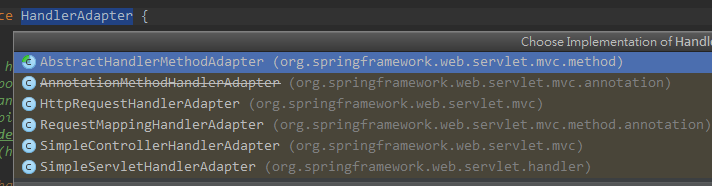
AnnotationMethodHandlerAdapter 基于HTTP请求的路径,方法,请求参数,使用 RequestMapping 注解来映handler,从 Spring 3.2建议使用RequestMappingHandlerAdapter。这里看看AnnotationMethodHandlerAdapter是如何实现handle方法的, 使用了反射,最后通过 invokeHandlerMethod 执行了对应的handler方法。
@Overridepublic ModelAndView handle(HttpServletRequest request, HttpServletResponse response, Object handler)throws Exception {Class<?> clazz = ClassUtils.getUserClass(handler);Boolean annotatedWithSessionAttributes = this.sessionAnnotatedClassesCache.get(clazz);if (annotatedWithSessionAttributes == null) {annotatedWithSessionAttributes = (AnnotationUtils.findAnnotation(clazz, SessionAttributes.class) != null);this.sessionAnnotatedClassesCache.put(clazz, annotatedWithSessionAttributes);}if (annotatedWithSessionAttributes) {checkAndPrepare(request, response, this.cacheSecondsForSessionAttributeHandlers, true);}else {checkAndPrepare(request, response, true);}// Execute invokeHandlerMethod in synchronized block if required.if (this.synchronizeOnSession) {HttpSession session = request.getSession(false);if (session != null) {Object mutex = WebUtils.getSessionMutex(session);synchronized (mutex) {return invokeHandlerMethod(request, response, handler);}}}return invokeHandlerMethod(request, response, handler);}protected ModelAndView invokeHandlerMethod(HttpServletRequest request, HttpServletResponse response, Object handler)throws Exception {ServletHandlerMethodResolver methodResolver = getMethodResolver(handler);Method handlerMethod = methodResolver.resolveHandlerMethod(request);ServletHandlerMethodInvoker methodInvoker = new ServletHandlerMethodInvoker(methodResolver);ServletWebRequest webRequest = new ServletWebRequest(request, response);ExtendedModelMap implicitModel = new BindingAwareModelMap();Object result = methodInvoker.invokeHandlerMethod(handlerMethod, handler, webRequest, implicitModel);ModelAndView mav =methodInvoker.getModelAndView(handlerMethod, handler.getClass(), result, implicitModel, webRequest);methodInvoker.updateModelAttributes(handler, (mav != null ? mav.getModel() : null), implicitModel, webRequest);return mav;}
小结
不要满足于得心应手的事,要不断的做触及能力之上的东西,才会成长。
