@Zemel-Yang
2016-12-04T17:49:09.000000Z
字数 2165
阅读 1376
Exercise 11: Chaotic Tumbling of Hyperion
python homework
Abstruct
In this exercise we will analyse the motion of Hyperion. We cosider it as two particles connected by a maeeless rigid rod. We will draw the figures of versus time for different initial conditions. And examine the relation between Lyapunov exponent and eccentricity.
Introduction and background
Hyperion, also known as Saturn VII (7), is a moon of Saturn discovered by William Cranch Bond, George Phillips Bond and William Lassell in 1848. It is distinguished by its irregular shape, its chaotic rotation, and its unexplained sponge-like appearance. It was the first non-round moon to be discovered.
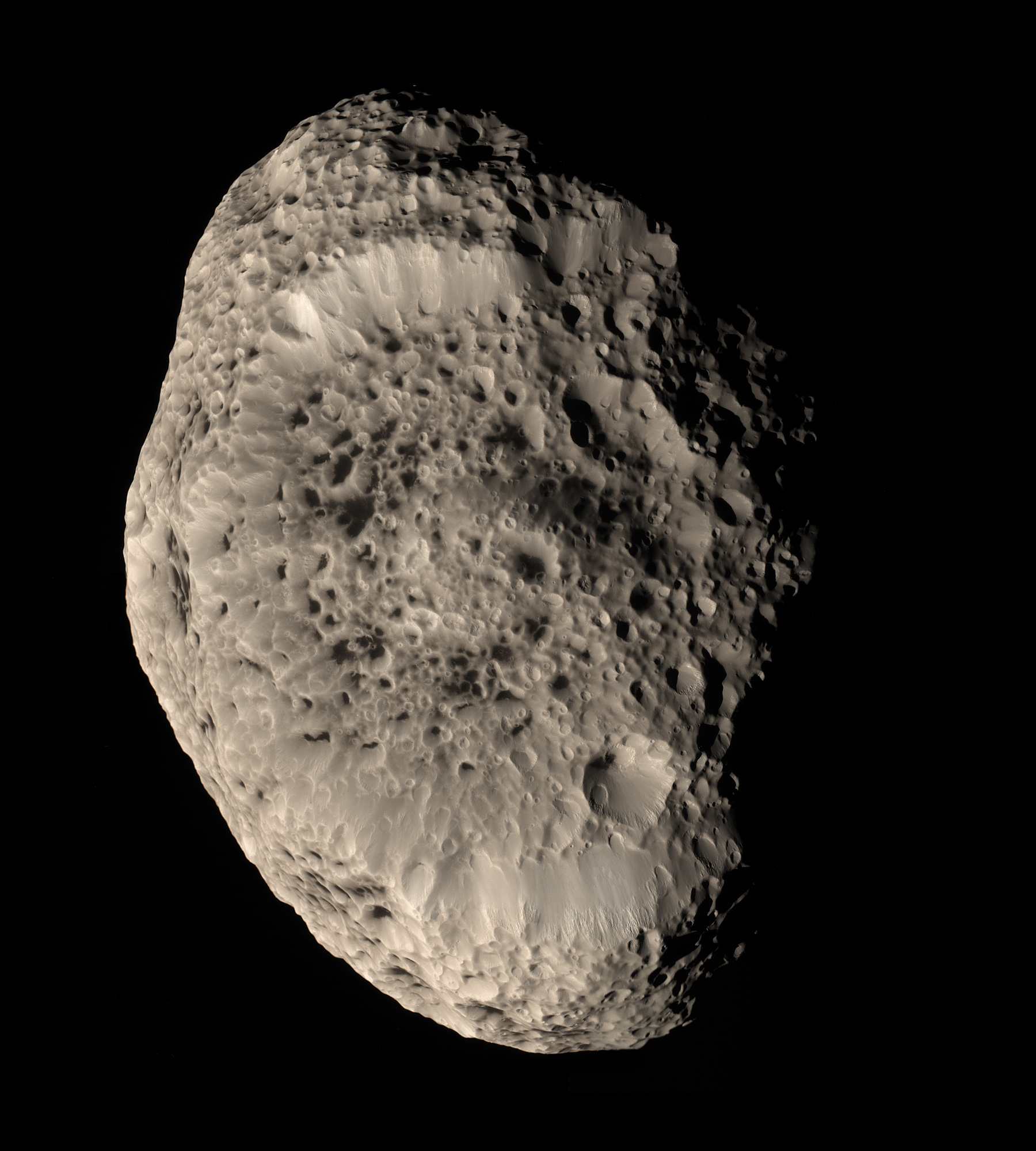
Hyperion is one of the largest bodies known to be highly irregularly shaped (non-ellipsoidal, i.e. not in hydrostatic equilibrium) in the Solar System. The only larger moon known to be irregular in shape is Neptune's moon Proteus. Hyperion has about 15% of the mass of Mimas, the least massive known ellipsoidal body. The largest crater on Hyperion is approximately 121.57 km (75.54 mi) in diameter and 10.2 km (6.3 mi) deep. A possible explanation for the irregular shape is that Hyperion is a fragment of a larger body that was broken up by a large impact in the distant past. A proto-Hyperion could have been 350–1,000 km (220–620 mi) in diameter. Over about 1,000 years, ejecta from a presumed Hyperion breakup would have impacted Titan at low speeds, building up volatiles in the atmosphere of Titan.
It is a simplified Hyperion System.

Content
- Problem 4.19
Study the behavior of our model for Hyperion for different initial conditions. Estimate the Lyapunov exponent from calculations of , such as those shown in Figure 4.19. Examine how this exponent varies as a function of the eccentricity of the obit. - Figure 1: Tumbling of Hyperion calculated assuming a circular obit. For simplicity we took the unit of length to the radius of Hyperion orbit(1HU), and that of time to be the orbital period of Hyperion around Saturn(1 "Hyperion year"). And take .Time step is 0.0001 Hyperion-year.

- Figure 2: Elliptical orbit. Here I take .

- Figure 3: versus time for circular orbit and elliptical orbit.

- Figure 4: Take different values of e.

For code, please click here
Conlusion
We see that for circular orbit or small e. Hyperion's motion is not chaotic. But when we take larger e, the motion become unpredictable and veries sharply if we sightly change the initial condition .
Reference
- Wikipedia-Hyperion
- Essentials of Hamiltonian Dynamics-John H. Lowenstein
