@2014301020054
2016-10-16T16:55:18.000000Z
字数 2270
阅读 1312
Exercise_5:The Trajectory of a cannon shell
physics python
Abstract
- I plan to choose problem_2.6 to make a practice.
Use the Euler method to calculate cannon shell trajectories ignoring both air drag and the effect of air density(actually, ignoring the former automatically rules out the latter). Compare your results with those in Figure 2.4, and with the exact solution.
Background
The Euler method we used to treat the bicycle problem can easily be generalized to deal with motion in two spatial dimensions. To be specific, we consider a projectile such as a shell shot by a cannon. We have a very large cannon in mind, and the large size will determine some of the important physics...
Main
Exercise_2.6
Use the Euler method to calculate cannon shell trajectories ignoring both air drag and the effect of air density(actually, ignoring the former automatically rules out the latter). Compare your results with those in Figure 2.4, and with the exact solution.
Solution
- Subroutine calculate for the cannon shell projectile using the Euler Method
Store position as and velocity as .
For each time step calculate position and velocity at step :
- Stop when or
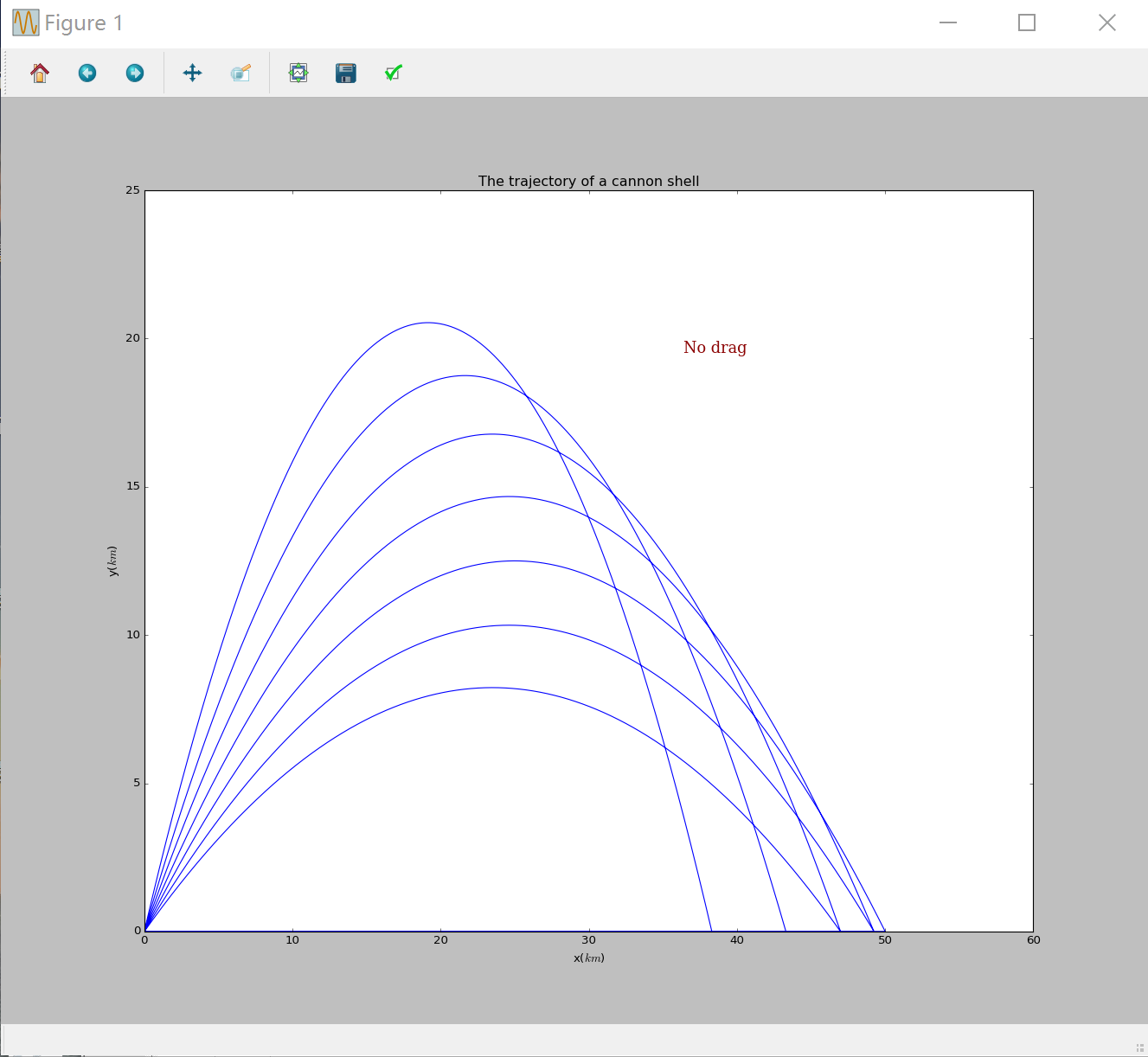
- We choose seven lines to show the different trajectors of the cannon shell by using loop statement
while.
Codes
import pylab as plimport math as mtclass cannon_shells:def __init__(self, initial_velocity = 0.7, g = 0.0098, range = 0, height = 0,\time_step = 0.01, initial_angle = 30.0, da = 5.0):self.v = [initial_velocity]self.a = [initial_angle]self.g = gself.dt = time_stepself.da = daself.x = [range]self.y = [height]def run(self):_a = self.a[0]while(_a <= 60):_a += self.daself.a.append(self.a[-1] + self.da)t = 2 * mt.sin(_a / 180.0 * mt.pi) * self.v[0]/self.gvx = mt.cos(_a / 180.0 * mt.pi) * self.v[0]vy = mt.sin(_a / 180.0 * mt.pi) * self.v[0]_time = 0xi = [0]yi = [0]while(_time < t):xi.append(xi[-1] + self.dt * vx)yi.append(yi[-1] + self.dt * vy)vx = vxvy = vy - self.g * self.dt_time += self.dtself.x = self.x + xiself.y = self.y + yidef show_results(self):font = {'family': 'serif','color': 'darkred','weight': 'normal','size': 16,}pl.title('The trajectory of a cannon shell')pl.text(0.95 * self.x[-1], 0.95 * max(self.y),\'No drag', fontdict=font)pl.plot(self.x,self.y)pl.xlabel('x($km$)')pl.ylabel('y($km$)')pl.show()a = cannon_shells()a.run()a.show_results()
- Running result:
Conclusion
The results are the same as those in Figure 2.4.
This is a exact solution.
