@574718927
2017-12-26T10:09:39.000000Z
字数 6383
阅读 172
Final Project : Fractal
Introduction
The word "fractal" often has different connotations for laypeople than for mathematicians, where the layperson is more likely to be familiar with fractal art than a mathematical conception. The mathematical concept is difficult to define formally even for mathematicians, but key features can be understood with little mathematical background.

The feature of "self-similarity", for instance, is easily understood by analogy to zooming in with a lens or other device that zooms in on digital images to uncover finer, previously invisible, new structure. If this is done on fractals, however, no new detail appears; nothing changes and the same pattern repeats over and over, or for some fractals, nearly the same pattern reappears over and over. Self-similarity itself is not necessarily counter-intuitive (e.g., people have pondered self-similarity informally such as in the infinite regress in parallel mirrors or the homunculus, the little man inside the head of the little man inside the head...). The difference for fractals is that the pattern reproduced must be detailed.

This idea of being detailed relates to another feature that can be understood without mathematical background: Having a fractional or fractal dimension greater than its topological dimension, for instance, refers to how a fractal scales compared to how geometric shapes are usually perceived. A regular line, for instance, is conventionally understood to be 1-dimensional; if such a curve is divided into pieces each 1/3 the length of the original, there are always 3 equal pieces. In contrast, consider the Koch snowflake. It is also 1-dimensional for the same reason as the ordinary line, but it has, in addition, a fractal dimension greater than 1 because of how its detail can be measured. The fractal curve divided into parts 1/3 the length of the original line becomes 4 pieces rearranged to repeat the original detail, and this unusual relationship is the basis of its fractal dimension.

This also leads to understanding a third feature, that fractals as mathematical equations are "nowhere differentiable". In a concrete sense, this means fractals cannot be measured in traditional ways. To elaborate, in trying to find the length of a wavy non-fractal curve, one could find straight segments of some measuring tool small enough to lay end to end over the waves, where the pieces could get small enough to be considered to conform to the curve in the normal manner of measuring with a tape measure. But in measuring a wavy fractal curve such as the Koch snowflake, one would never find a small enough straight segment to conform to the curve, because the wavy pattern would always re-appear, albeit at a smaller size, essentially pulling a little more of the tape measure into the total length measured each time one attempted to fit it tighter and tighter to the curve.
Abstract
This eaasy will show some classsic fractal patterns, from the easist Cantor ternary set to Koch curve and Hilbert-Peano curve, and so on.In the meanwhile, I will give the arithmetic of those farctal patterns, includeing reursive algorithm and L-System methods.
And all the codes ware written by Java.
Reursive Algorithm
Cantor ternary set
In mathematics, the Cantor set is a set of points lying on a single line segment that has a number of remarkable and deep properties. It was discovered in 1874 by Henry John Stephen Smith and introduced by German mathematician Georg Cantor in 1883.

Through consideration of this set, Cantor and others helped lay the foundations of modern point-set topology. Although Cantor himself defined the set in a general, abstract way, the most common modern construction is the Cantor ternary set, built by removing the middle thirds of a line segment. Cantor himself mentioned the ternary construction only in passing, as an example of a more general idea, that of a perfect set that is nowhere dense.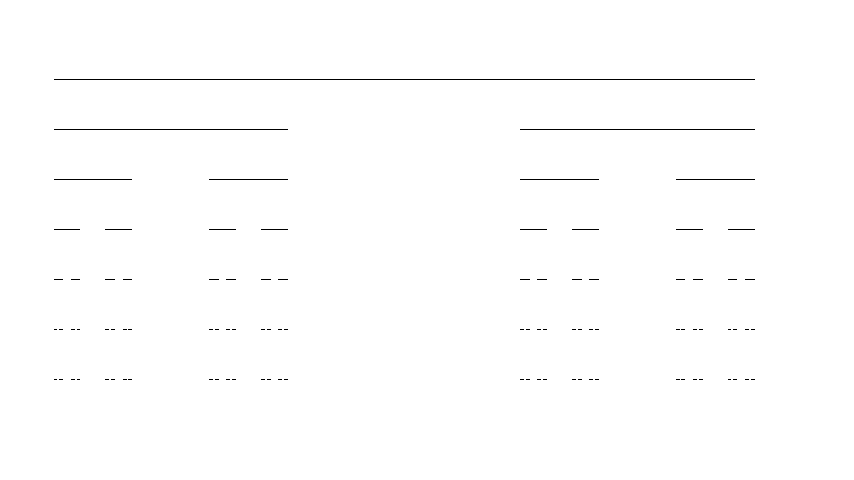
the pattern of cantor ternary setKoch Curve
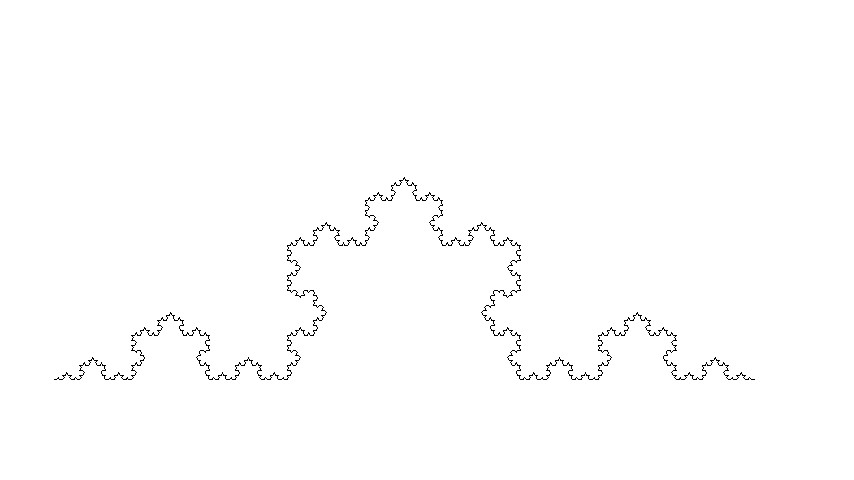
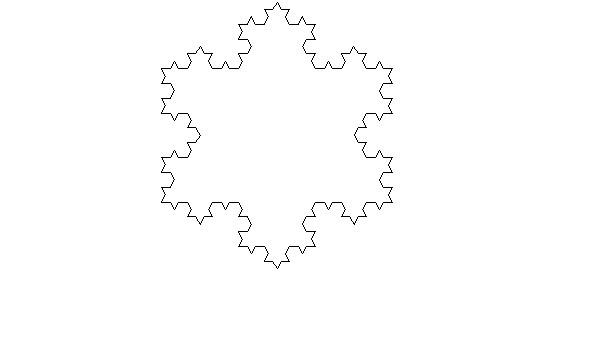
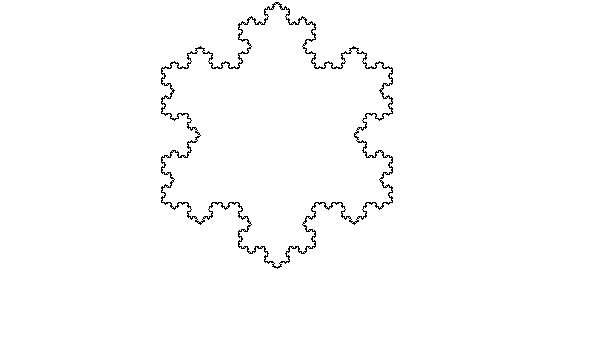
The Koch snowflake is a mathematical curve and one of the earliest fractal curves to have been described. It is based on the Koch curve, which appeared in a 1904 paper titled "On a continuous curve without tangents, constructible from elementary geometry" by the Swedish mathematician Helge von Koch.
The progression for the area of the snowflake converges to times the area of the original triangle, while the progression for the snowflake's perimeter diverges to infinity. Consequently, the snowflake has a finite area bounded by an infinitely long line.
the part of Koch snowflake:
Koch Snowflake
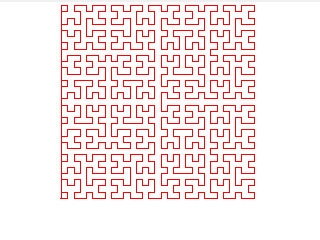
Hillbert-Peano curve
A Hilbert curve (also known as a Hilbert space-filling curve) is a continuous fractal space-filling curve first described by the German mathematician David Hilbert in 1891, as a variant of the space-filling Peano curves discovered by Giuseppe Peano in 1890.
L-System method
Exscept reursive algorithm, we can also use L-System to construct fractal pattern.
An L-system or Lindenmayer system is a parallel rewriting system and a type of formal grammar. An L-system consists of an alphabet of symbols that can be used to make strings, a collection of production rules that expand each symbol into some larger string of symbols, an initial "axiom" string from which to begin construction, and a mechanism for translating the generated strings into geometric structures. L-systems were introduced and developed in 1968 by Aristid Lindenmayer, a Hungarian theoretical biologist and botanist at the University of Utrecht. Lindenmayer used L-systems to describe the behaviour of plant cells and to model the growth processes of plant development. L-systems have also been used to model the morphology of a variety of organisms and can be used to generate self-similar fractals such as iterated function systems.
In L-system method, there are three keys, and a G is difinded by
where
1. V : a set of symbols containing both elements that can be replaced (variables) and those which cannot be replaced ("constants" or "terminals")
2. : a string of symbols from V defining the initial state of the system
3. P : a set of production rules or productions defining the way variables can be replaced with combinations of constants and other variables.
A production consists of two strings, the predecessor and the successor. For any symbol A which is a member of the set V which does not appear on the left hand side of a production in P, the identity production A → A is assumed; these symbols are called constants or terminals
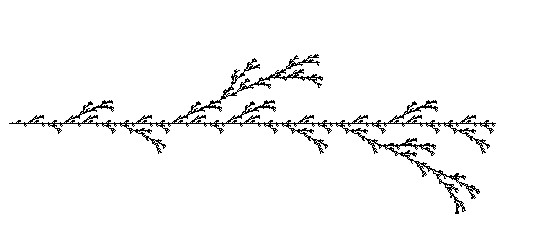
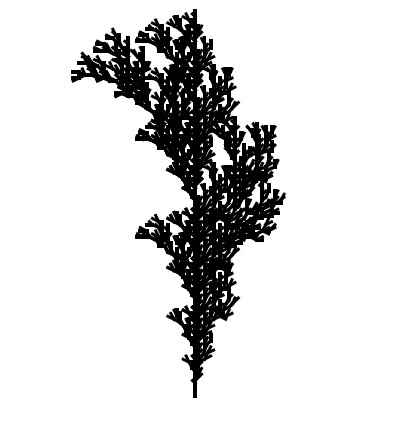
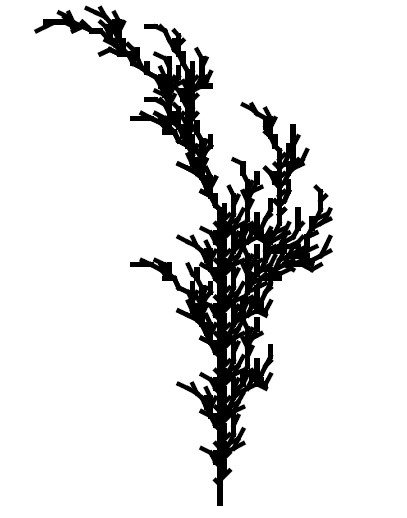
There are some examples by different LS rules:
More
There are more fantastic fractal pictures
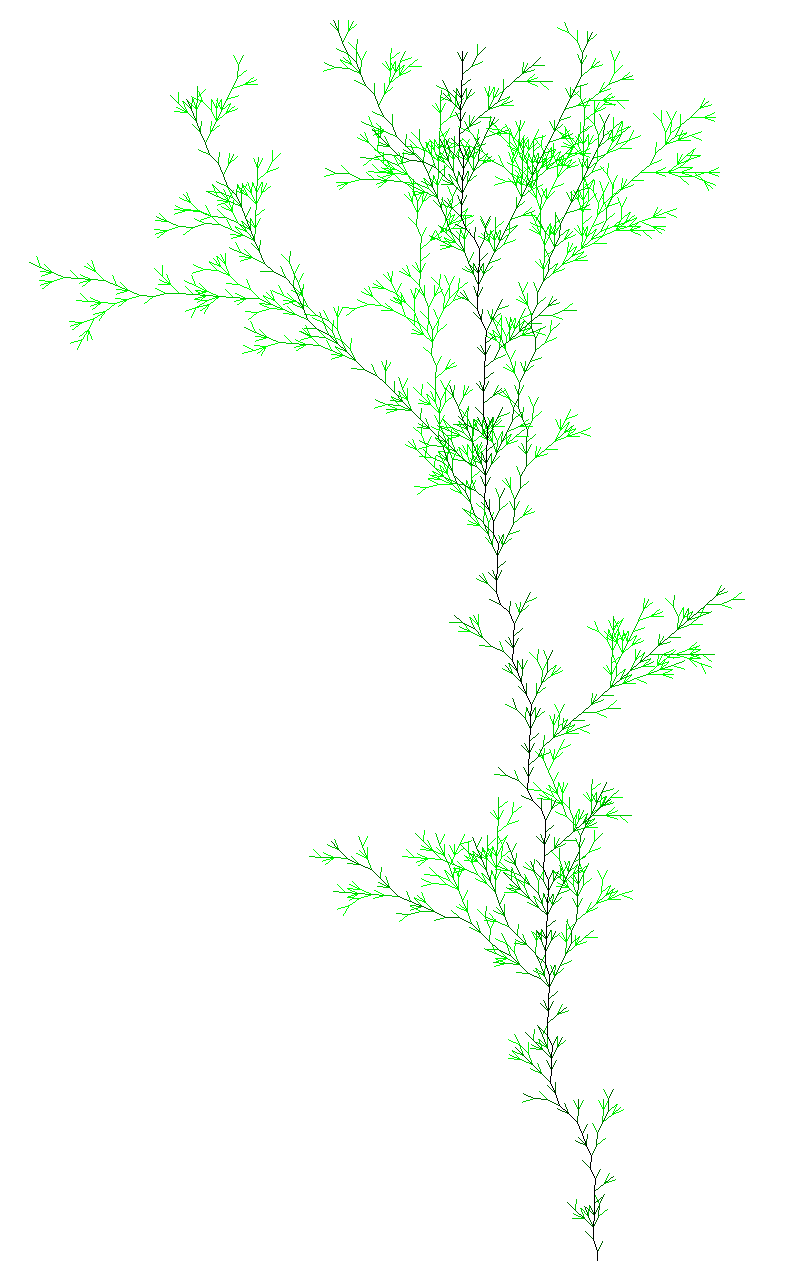
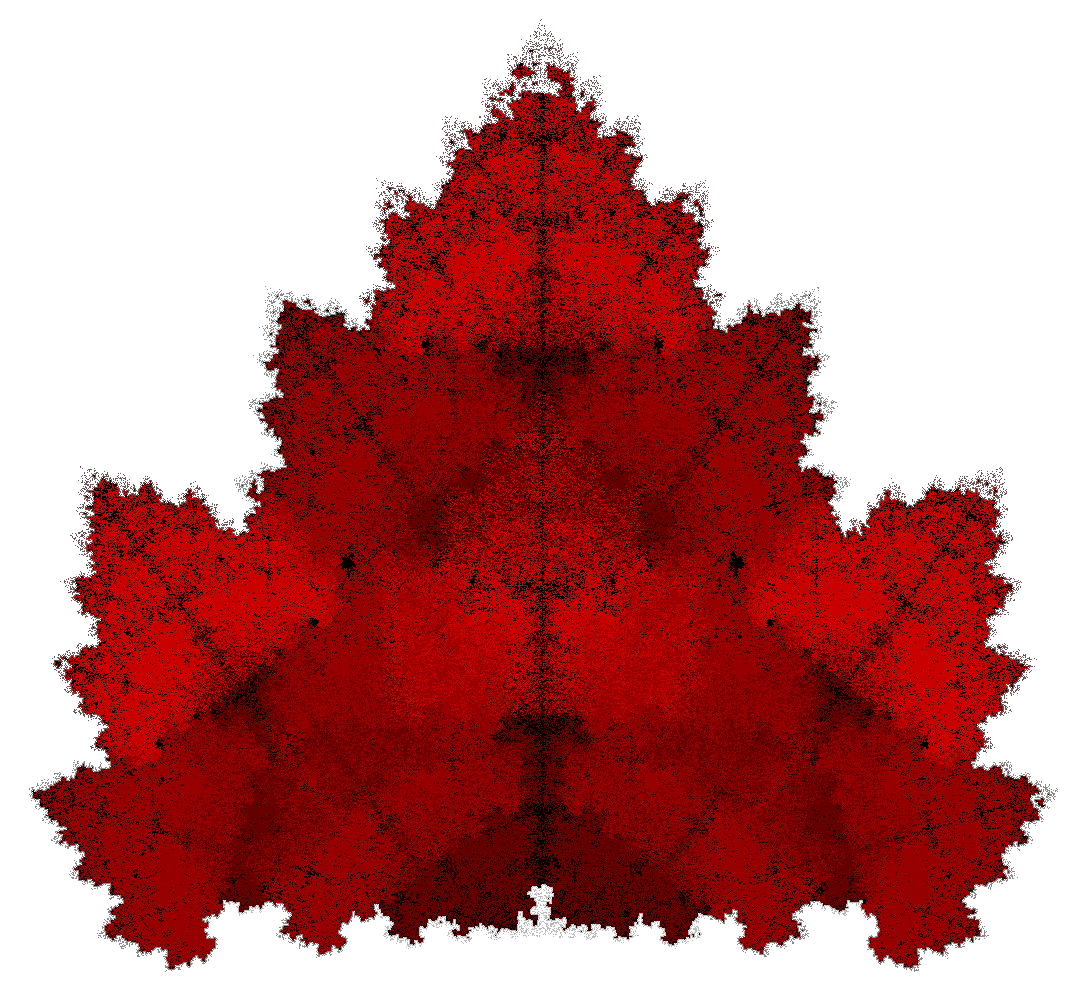
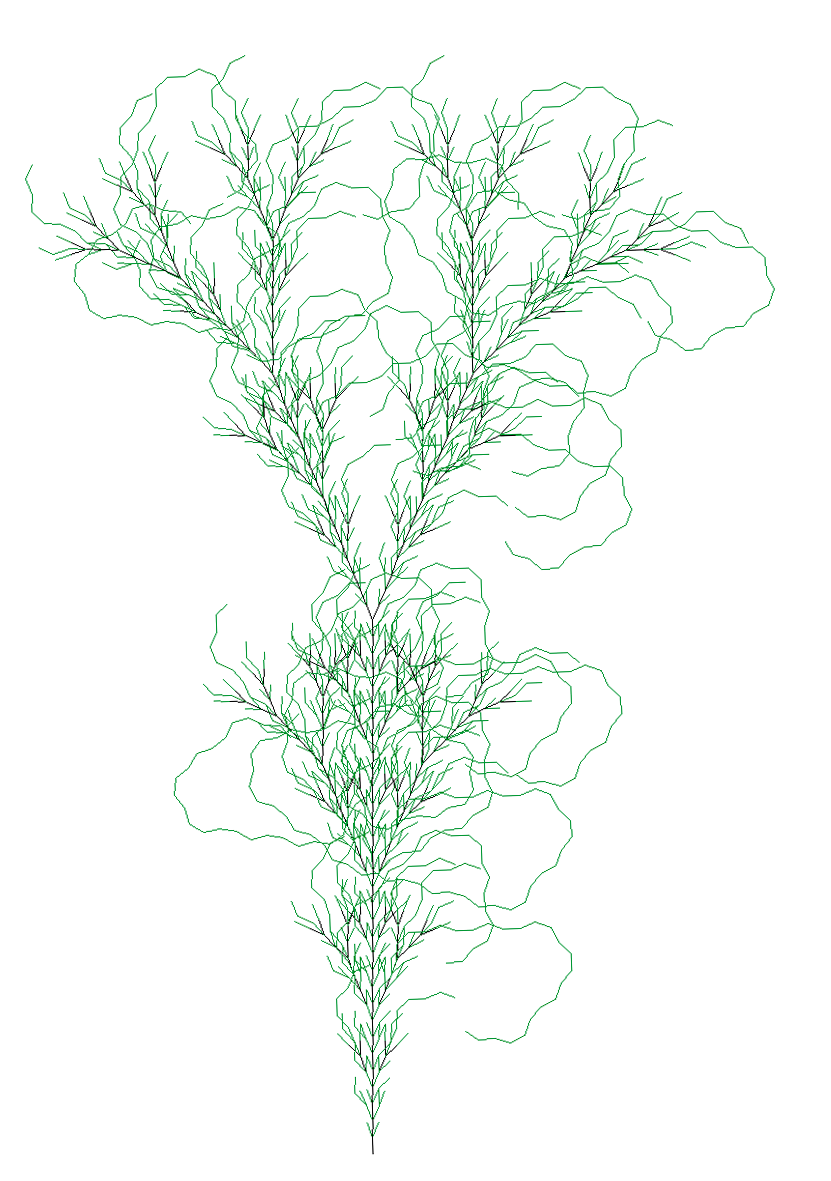
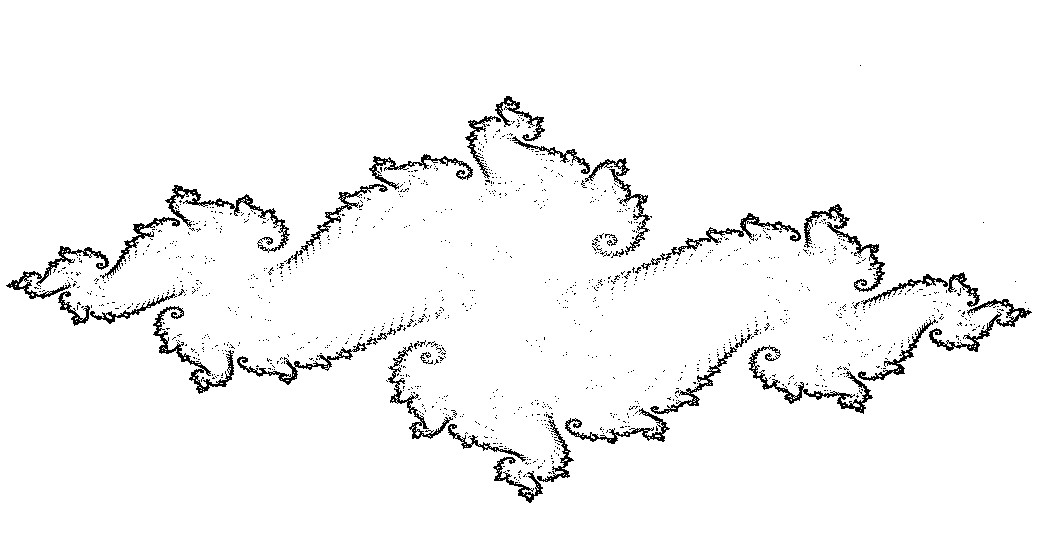
End
Using fractal theory, we can get planty intresting photos, but there is more than that.
In fact, the general consensus is that theoretical fractals are infinitely self-similar, iterated, and detailed mathematical constructs having fractal dimensions, of which many examples have been formulated and studied in great depth. Fractals are not limited to geometric patterns, but can also describe processes in time. Fractal patterns with various degrees of self-similarity have been rendered or studied in images, structures and sounds and found in nature, technology, art, Architecture and law. Fractals are of particular relevance in the field of chaos theory, since the graphs of most chaotic processes are fractal.
Gratitude
- Most of the codes come from Professor Sun's works.
- Thanks for Wikipeia.
