@NABLAfai
2016-06-17T17:11:54.000000Z
字数 2359
阅读 793
The 11th homework
-exercise 4.7 and 4.9
Abstract
This article discusses the motion of celestial bodies under gravitation which satisfies the inverse-square law. Then discusses the condition when the inverse-square law is false.
Background
Whatever the kinetic equation has and only has the factor correspondent to ( stands for the position vector between forced object and the source of the field) is called the "inverse-square law" in Physics,
the law of universal gravitation, for example, is one of them. Using the law of gravitation and Newton's laws of motion, we can easily get the equations and trajectories of planets' motion in solar system theoretically.
In the exercises, we will try to solve two-body problems of celestial body using numerical simulation. At last we will calculate the perihelion of planets if the order of is not .
Main
Equation of Motion
In the solar system, the equation of gravitation yeild:
Togather with the Newton's law of motion, we can get the rule of planets' movement. From the kinetic equation, we can get the trajectory equation of planet, or the equation of orbit. That is
Where , is the eccentricity ot the orbit. The value of can decide the shape of the orbit.
From the orbit equation we can get the Kepler's law of planet motion. But we should notice that all these laws and inferences are results of the inverse-square law, which is to say once the force doesn't satisfy the inverse-square law, all the inferences will be demolished.
4.7 Binary star
Solve the two body system in a rest frame using numerical simulation:
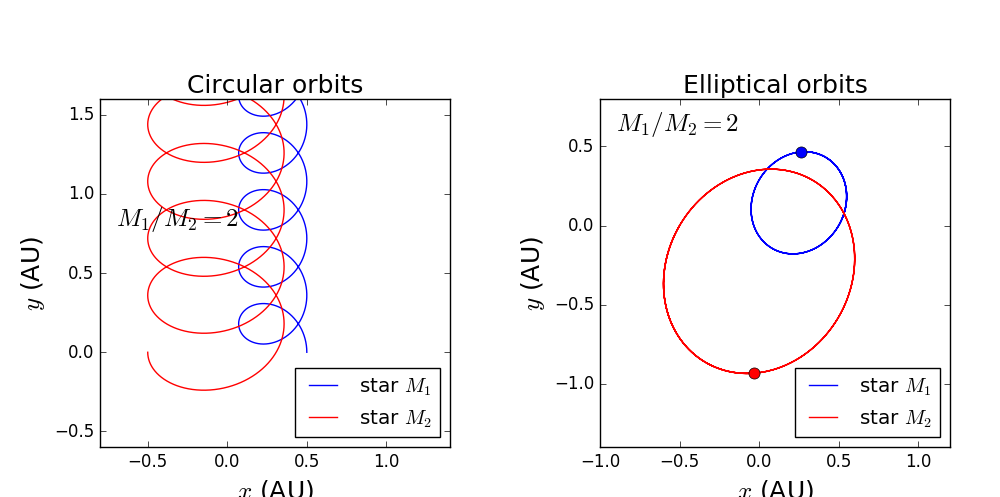
We can see that the orbit highly depend on the initial conditions. The orbit can be eliptical and helix under different initial conditions.
4.9 None inverse-square condition
if the gravitation satisfies the equation
This will cause the perihelion of the planet's orbit's precession, let's see with the calculation of the numerical method:
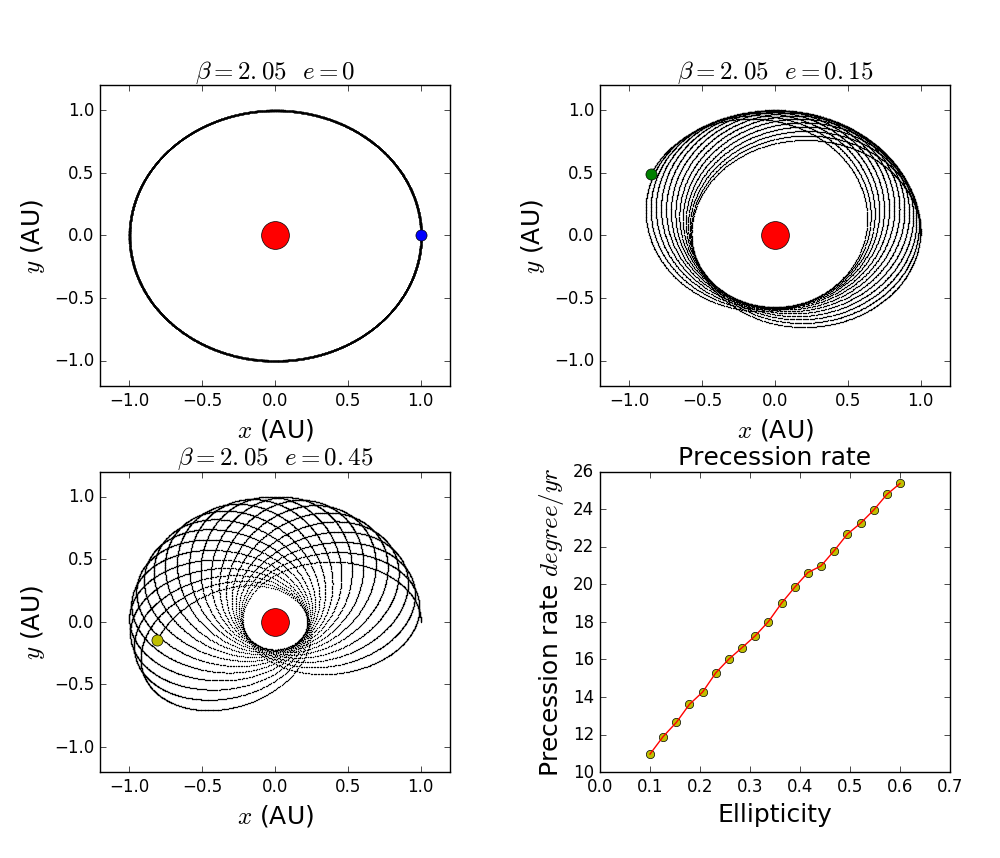
We can see that only when can the orbit maintain a closed curve. If the initial eccentricity is not zero, the precession will happen.(see picture b and c) The last picture shows the relationship between the precession speed(expressed by the angular velocity of the perihelion). The larger the eccentricity is, the faster the precession will be.
Conclusion
Binary system is much more comlicated than the one-star-fixed system, the status highly depends on the initial condition of the two stars. But it is still predictable and has regularities. And if the order of is not , the motion of planets will be much more complicated too.
Reference
Computational Physics-Nicholas J. Giordano, Hisao Nakanishi
