@NABLAfai
2016-06-16T15:47:42.000000Z
字数 3574
阅读 599
The eighth assignment
物基一班
陈天懿 2013301020146
Abstract
This article mainly discusses the motion of a simple pendulum, starts with the simple harmonic vibration, then we include the forced vibration with damping. At last, we solve the problem 3.8.
Bacground
As we all know, vibration is all over the whole physical world, such as the motion of the electrics in the atom, motion of a sting and motion of a pendulum. The vibration of the simple pendulum in ideal situation is the simplest one known as the harmonic vibration. When we take more and more factors into account, such as damp and external force, the vibration becomes more and more complex, there will even occur so called "chaos" phenomena.
Main
Simple Harmonic Vibration
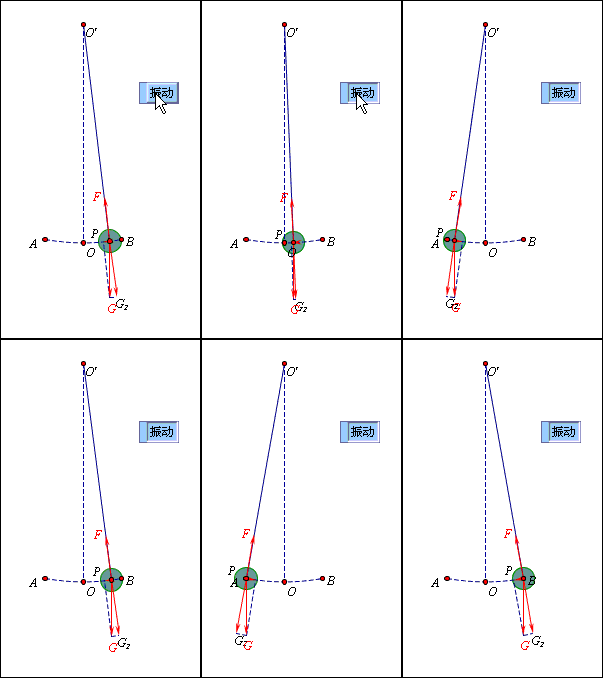
First we consider a particle with mass m. It is tight on a string with one end fixed at a pivot point. Assume there are only gravity and tension force acting on the particle, then we get the kinetic equations:
Using small angle approximation, we can substitute with . Thus we get
Then we solve the equation with analyis method, the solution is:
Where , is the acceleration of gravity and is the length of the light string.
We can see from the solution that in simple harmonic vibration, the angular velocity of the vibration is decided by the acceleration of gravity and the length of the string, which is independent of the mass of the particle.
Then we use the Euler-Cromer method to do the numerical simulation, draw the function of angle respect to time . The release angles is set to , and respectively, lengths of the string are all set to 1.
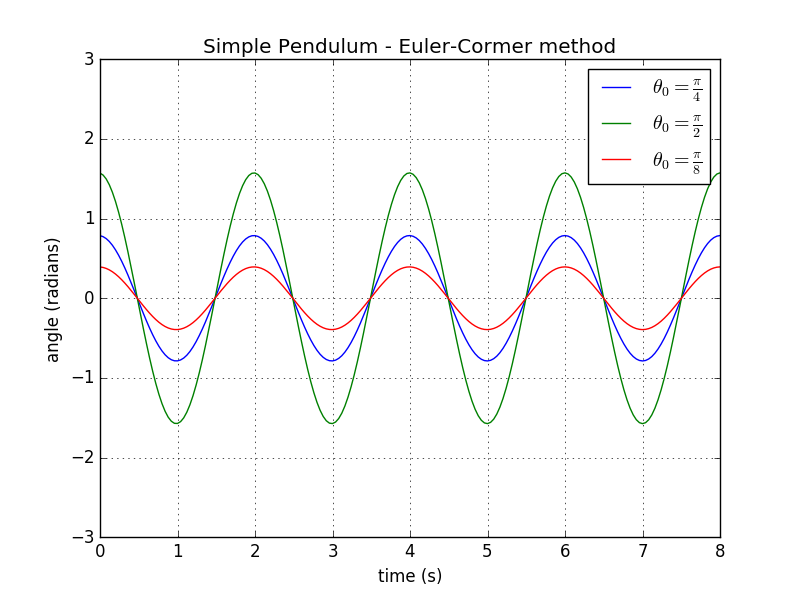
We can clearly see from the picture that it satisfies the result we get from the analysis method, which proves that the period of the vibration is indeed independent to the particle itself, but only dependent to the acceleration of gravity and the length of the string , precisely, .
Forced vibration with damping
Omitted the procedure, I directly show you the motion equation of the pendulum, which is:
Where , is the damping coefficient, is the amplitude of the external force, is the angular frequency of the external force.
Still we do the numerical simulation
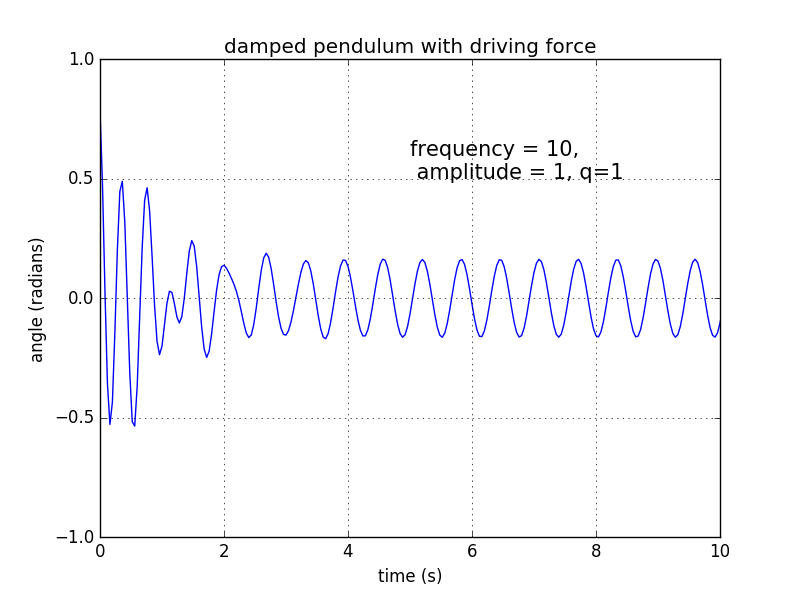
It is clear that the pendulum will finally do harmonic vibration, its amplitude is dicided by its intrincic frequency frequency of the external force and its damping coefficient, The frequency is the same as the external's frequency.
None Linear pendulum
The analysis result is the small angle approximation of the actual case, actually, the equation yields:
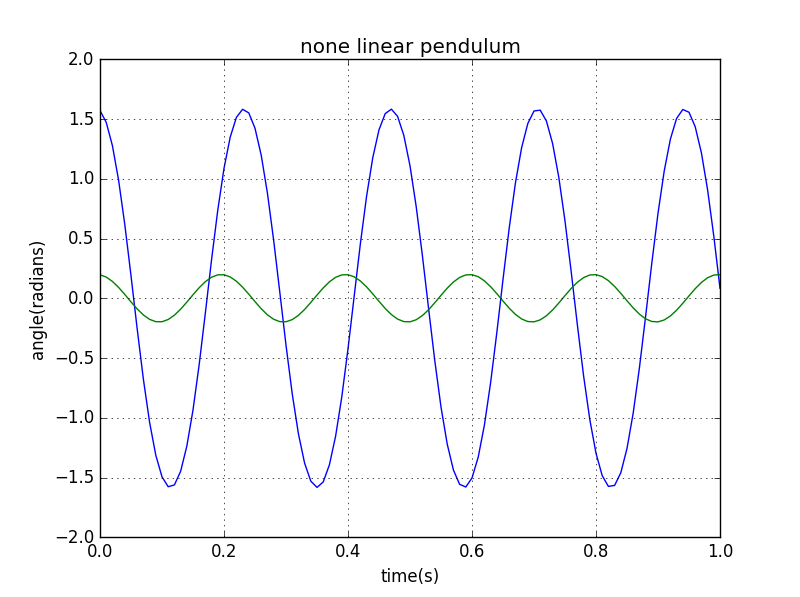
From the numerical simulation, we find that it is still periodic motion, and under small angle situation, the two motion images are quite similar to each other, however, when release angle becomes relatively big, the period becomes longer than the smaller one, that is to say, the initial condition has some kind of effect on the period of the vibration.
the Relation Between Period and Amplitude of the None Linear Pendulum--Problem 3.8
The exercise ask us to find the relation between the period and the amplitude of the none linear pendulum. And the amplitude only depends on the release angle, so we claculate different periods of different release angles and draw the period-release angle diagram.
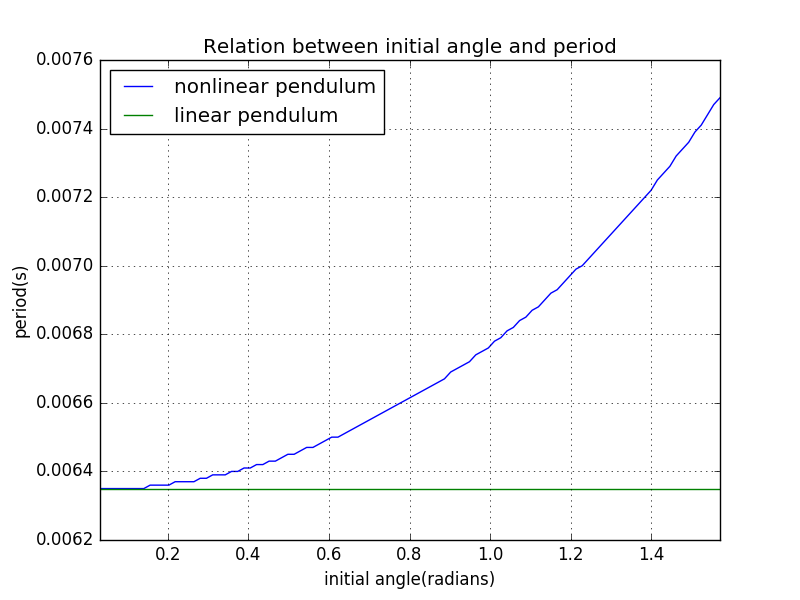
We can see that when the amplitude is relatively small, the correspondent period tends to be a constant, when the amplitude becomes larger, the period becomes larger as the picture shows.
see codes here
see codes here
see codes here
see codes here
Conclusion
To linear pendulum has a fixed period no matter how the amplitude change, but the none linear pendulum is different. The period tends to be a constant when the amplitude is small, when the amplitude becomes larger, the period becomes larger.
Reference
Computational Physics-Nicholas J. Giordano, Hisao Nakanishi
