@NABLAfai
2016-06-17T13:31:53.000000Z
字数 1785
阅读 814
The tenth homework
Problem3.26 3.29
物基一班
陈天懿 2013301020146
Abstract
This article uses Euler method, studies the Lorenz model, and solves the exercise 3.26 and 3.29
Main
Lorenz model
The origin of Lorenz model
When Meteorologist Lorenz sdudied the Rayleigh-Benard problem, he simplified the fundamental equations of fluid dynamics as:
This set of equations if called the Lorenz equations, or Lorenz model. The , , are variables, the others are constants.
Lorenz model's different behavior under different parameter ""
Fix , , change the magnitude of , draw the picture of changing with time .( and 's behavior are pretty much like 's). stands for the temperature difference of the top and the bottom of the fluid.
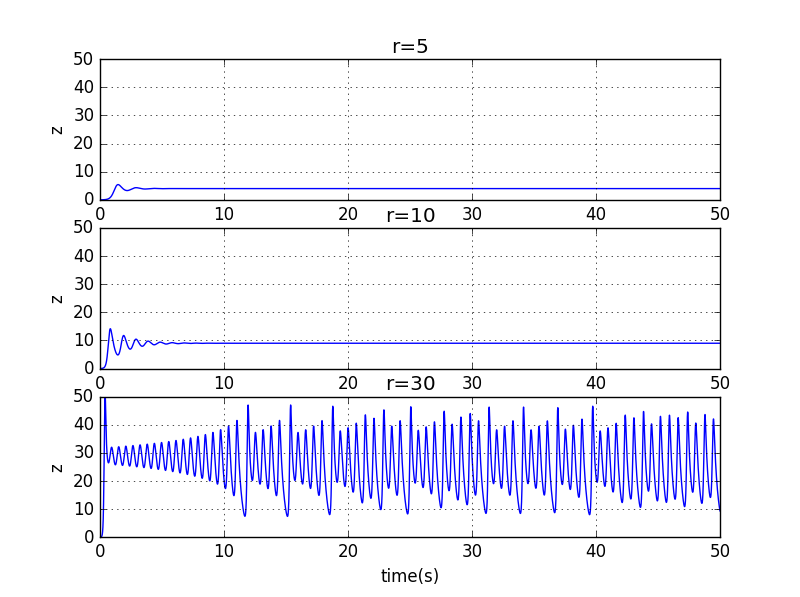
From the picture, we find that when is relatively small, will vibrate a little, but it will eventually become a constant, when is slightly larger, the two diagram still looks similar to each other, only it takes the second one more time to become steady. The last picture, when is large enouth, it will finally become chaos.
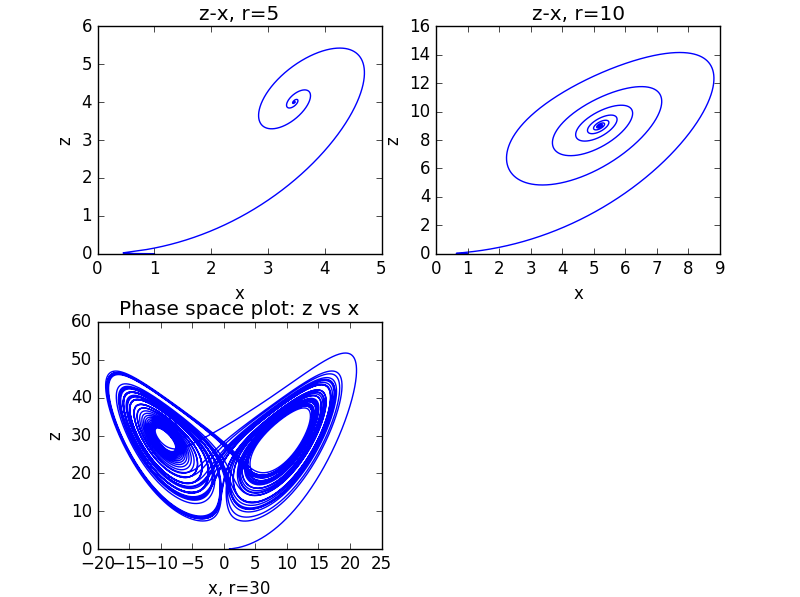
Lorenz model in the phase space
Considering the relation between and , draw the picture. of seperately. The last picture show a strange attractor, which is called "Lorenz attractor" in the Lorenz model.
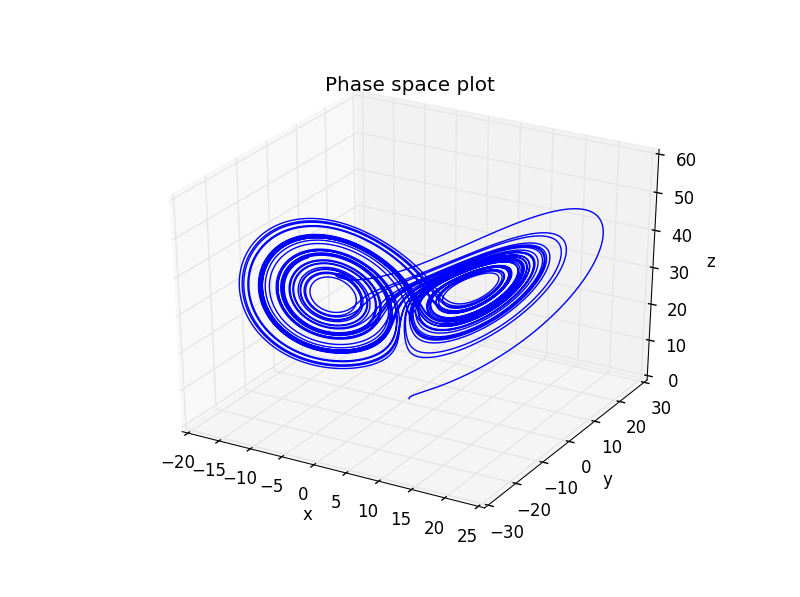
The Lorenz attractor from above in the coordinate:
Transform into chaos system
we can see from the picture from above that as grows larger, the Lorenz system becomes more chaos.
Motion of billiard balls with different
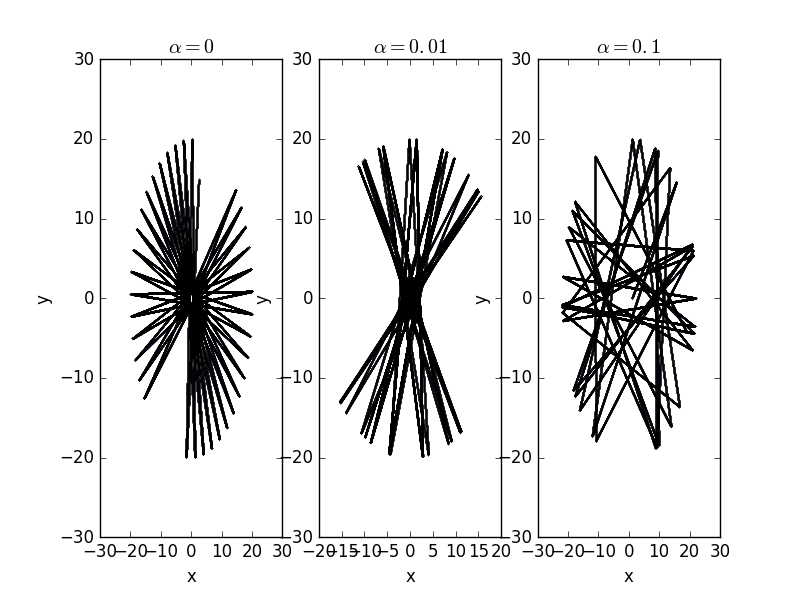
Clearly when becomes larger, the system acts more chaotic.
see codes here(all codes included)
Conclusion
Used Euler method to successfully simulate the Lorenz model and the motion of billiard balls.
In Lorenz model, when grows large enough, chaos will occur, and the larger the is, the more chaotic the system will be. And to the motion of billiard balls, the larger the is, the more chaotic there motion will be.
Reference
Computational Physics-Nicholas J. Giordano, Hisao Nakanishi
