@NABLAfai
2016-06-19T12:59:28.000000Z
字数 2273
阅读 665
The 14th homework
Problem 5.6 and 5.12
物基一班
陈天懿 2013301020146
Abstract
This article solves the wave equation using numerical method and solves the problem 5.6 5.12
Background
In physics, a wave is an oscillation accompanied by a transfer of energy that travels through medium (space or mass). Frequency refers to the addition of time. Wave motion transfers energy from one point to another, which displace particles of the transmission medium — that is, with little or no associated mass transport. Waves consist, instead, of oscillations or vibrations (of a physical quantity), around almost fixed locations.
Main
We have the one dimensional wave equation:
Where represents the displacement from the equilibrium position of a point, stands for the location of point on the axe.
To make the situation more like the reality, we add the damping term to the equation:
We obtain the iteration equation:
Then we study the spread of wave after we set a Gaussian disturbance on the string. The equation of the disturbance is:
We set length of the string to , , , then we get the spread of the wave as follows:
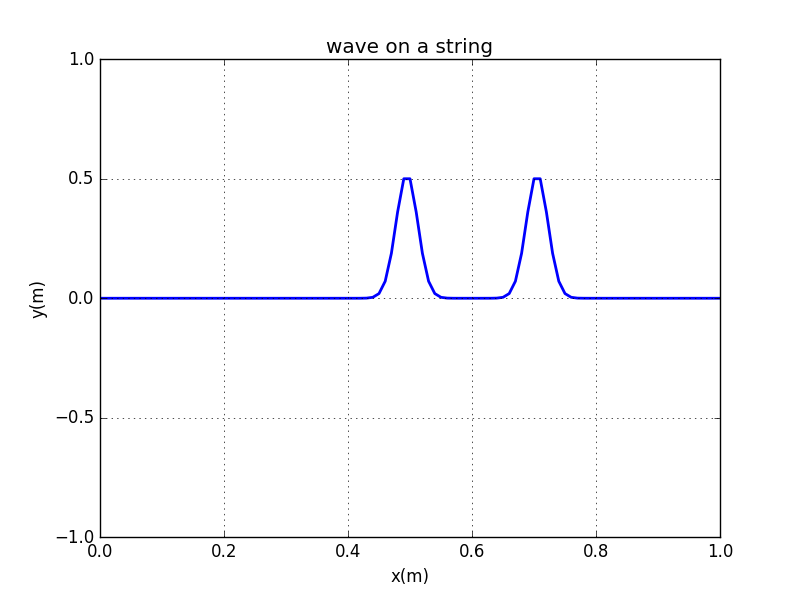
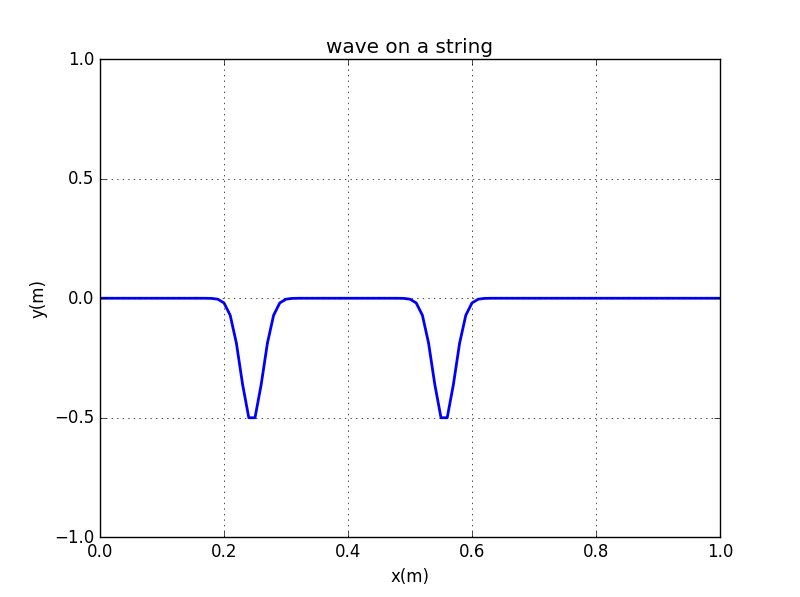
When the disturbance move to the ends of the string, the trough of the wave becomes the peak, and the peak becomes the trough. This is called "half wavelength loss" in physics. That is, when the wave comes from optically denser medium to optically thinner medium, the phase whill reduce .
Problem 6.6 the independence of each wave
We set two different disturbances on the string to see the spread of the wave:
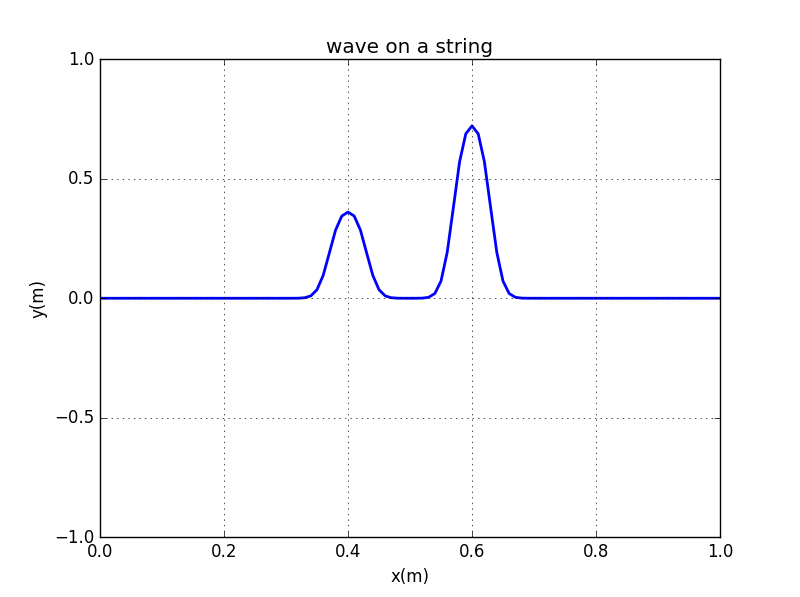
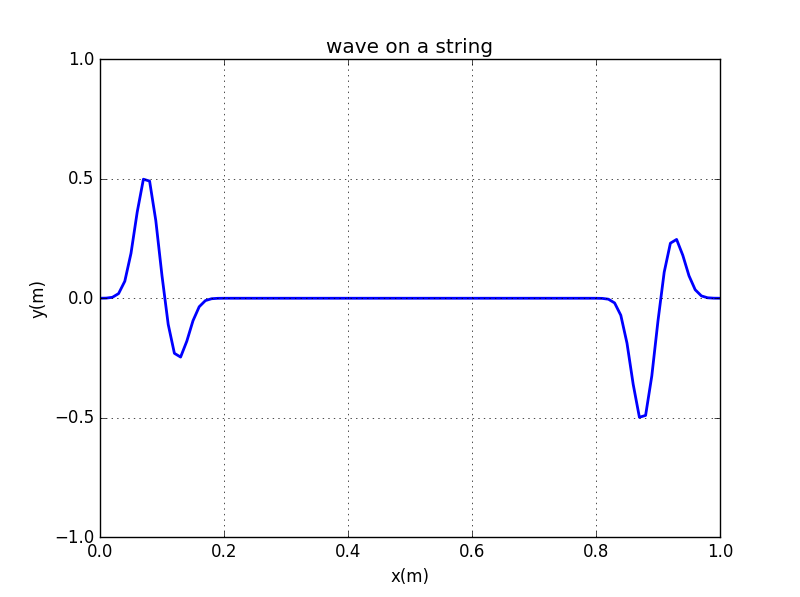
We can see that the waves caused by the disturbances are completely independent to each other. The properties of the waves such as shape and velocity remain the same before and after they join togather. So we can see that the solutions of the linear differential equation are independent to each other and satisfy the linear superposition principle.
Problem 6.12 the power spectrum of triangular wave
Let's study the triangular wave's power spectrum. The image of the signal is:
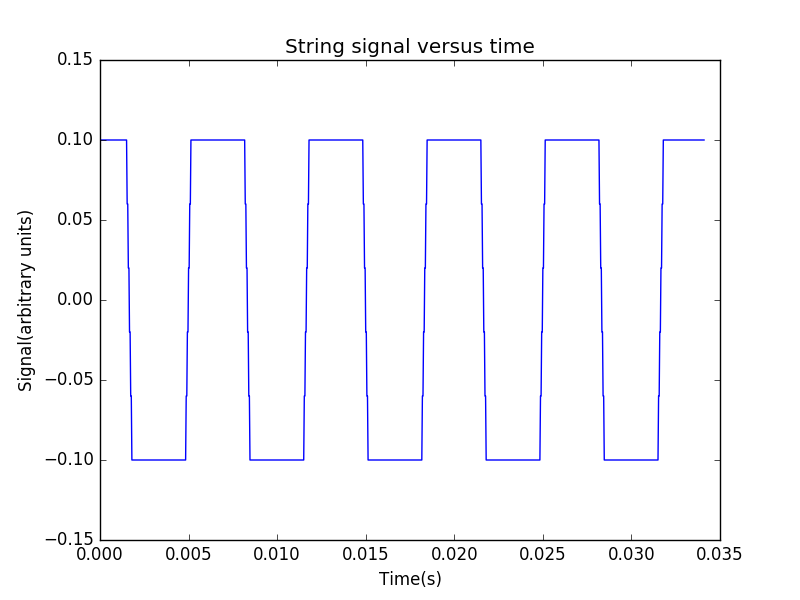
And the spectrum is:
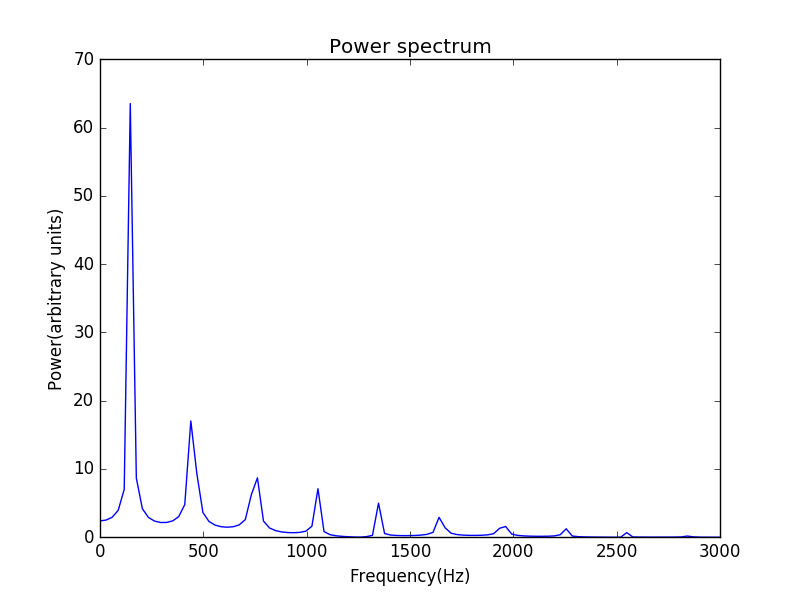
We can see that the peaks decrease when the frequency becomes larger.
see codes here(all codes included)
Conclusion
Solutions to all problems are listed above.
Reference
Computational Physics-Nicholas J. Giordano, Hisao Nakanishi
Special thanks to my roommate who helps me with the programming.
