@NABLAfai
2016-06-18T16:12:30.000000Z
字数 1623
阅读 642
The 13th homework
物基一班
陈天懿 2013301020146
Abstract
This article uses the Gauss-Seidel method to solve the Laplace equation, the compares the efficiency of it and the simultaneous over-relaxation method.
Background
In the space with no electric, the distribution of potential satisfies the well-known Laplace equation, that is:
To solve equation, we use the approximation:
Applay this procedure to all three partial derivatives we get:
Main
The potential disstribution of the point electric
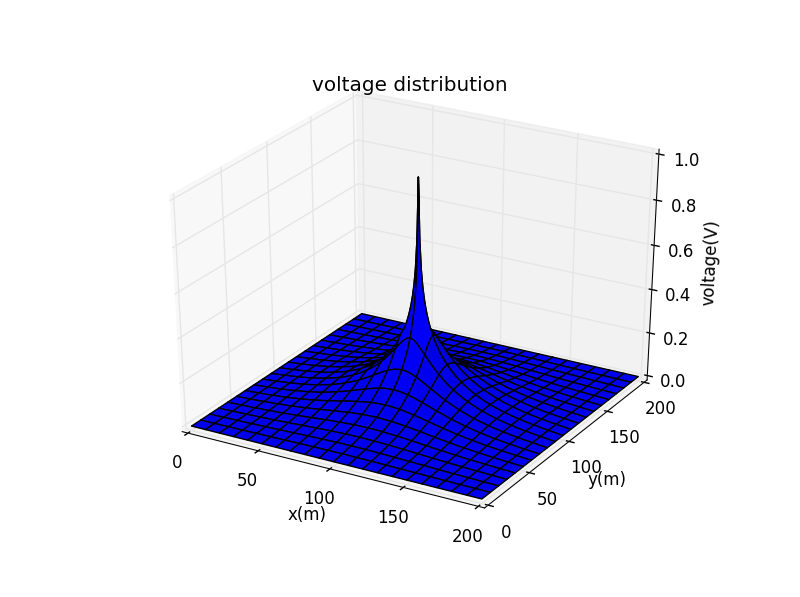
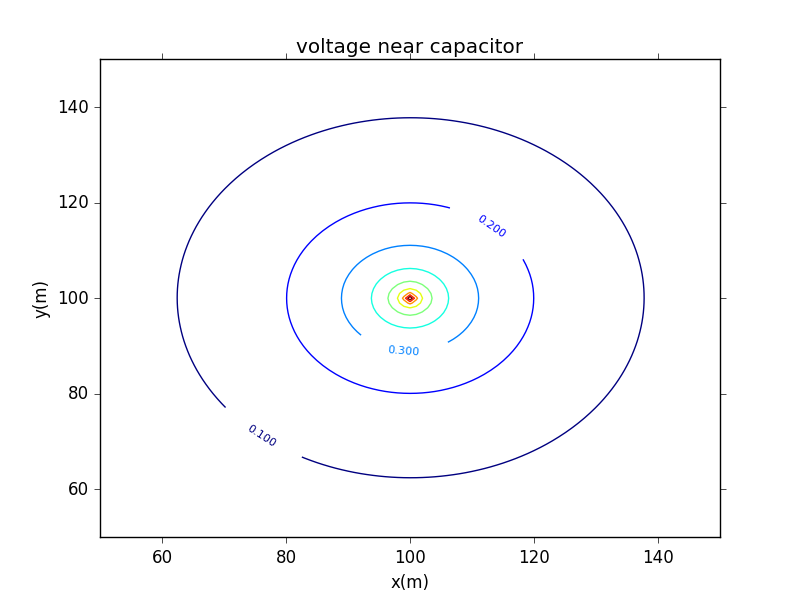
Boundry conditions for the point electric is none, means it has the free boundry condition.
The potential disstribution of the parallel-plate capacitor
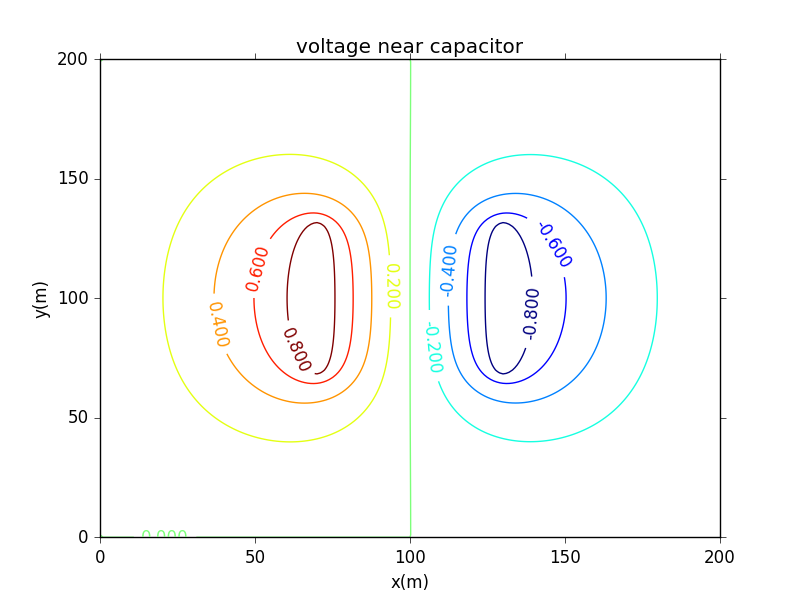
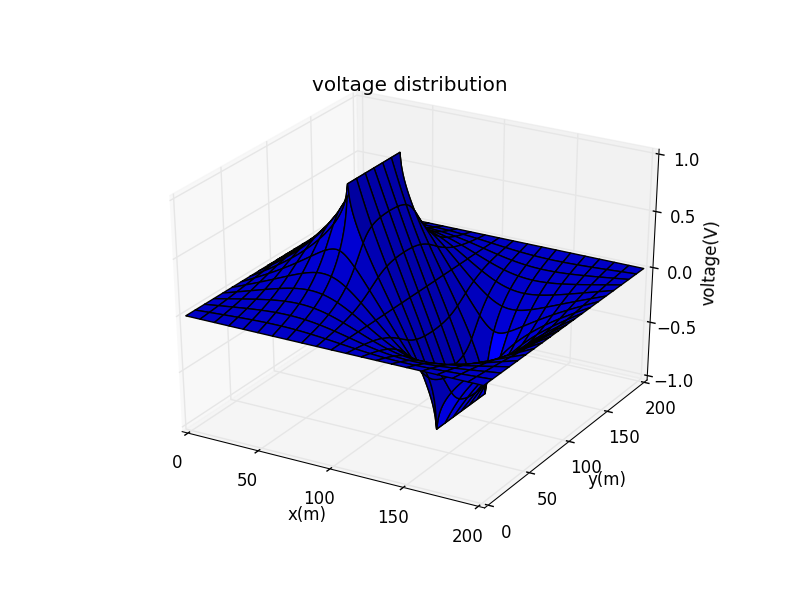
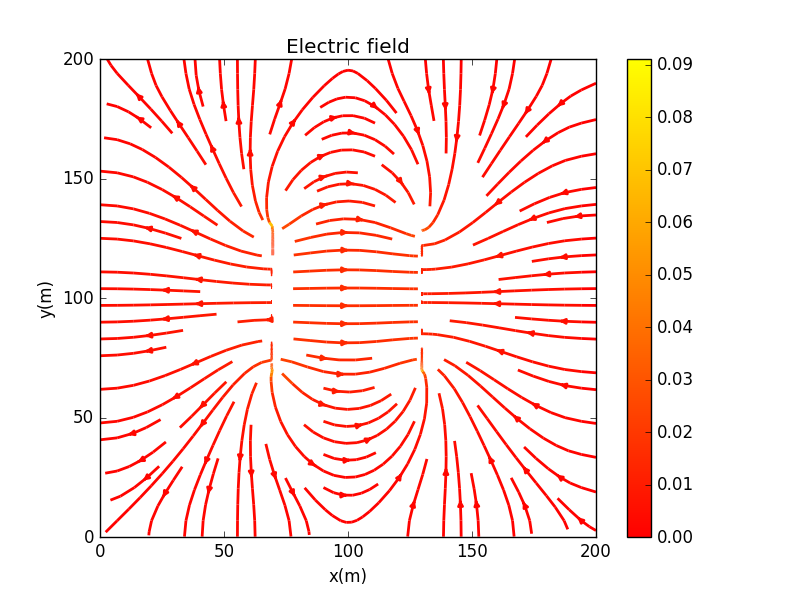
parallel-plate capacitor is: +1 on the left plate, -1 on the right plate
Comparison of the efficiency of the Gauss-Seidel method and the SOR method
Theoritically, the iteration steps needed for the Gauss-Seidel method is proportional to the square of the length of lattice. The SOR method is only proportional to the length. We can show this directly by the picture below:
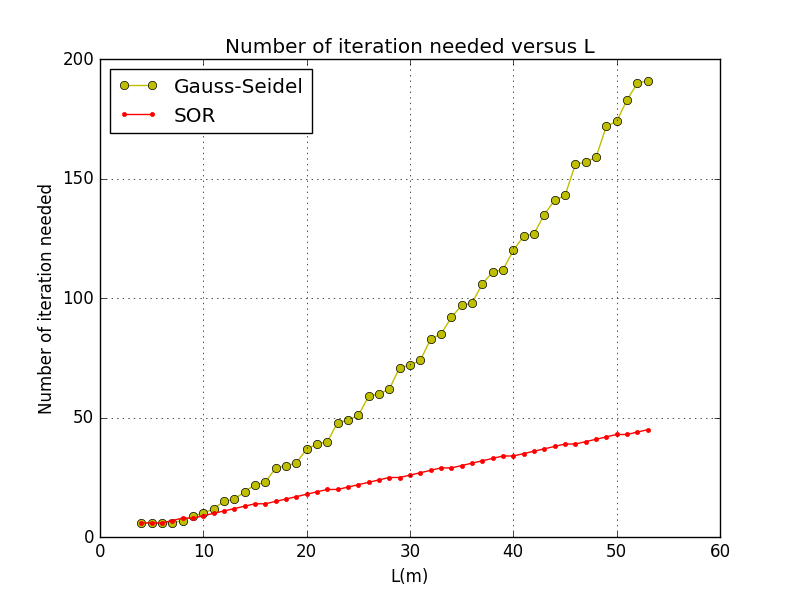
So the SOR method can increase the efficiency of calculation rapidly.
Conclusion
The validity of the numerical simulation of the distribution of electric potential is conformed for the results correspond with our knowledge of electromagnetism. And the SOR method is much more efficient than the Gauss-Seidel method.
Reference
Computational Physics-Nicholas J. Giordano, Hisao Nakanishi
