@OrionPaxxx
2019-03-25T11:03:53.000000Z
字数 1431
阅读 928
computationalphysics
exercise07:problem3.13
abstract
solution to problem3.13 of computational physics
key point:
1.plot the trajectory of two nearly identical pendulums
2.plot versus time
3.make a qualitative estimate of the corresponding Lyapunov exponent
background
physical equations
Euler_cromer calculation
if is out of the range [-,],add or subtract to keep it in this range.
parameters
main body
click here to check the main code
1.plot the trajectory of two nearly identical pendulums
a=chaotic_pendulums()a.pendulum()a.show_result()
here is the plot
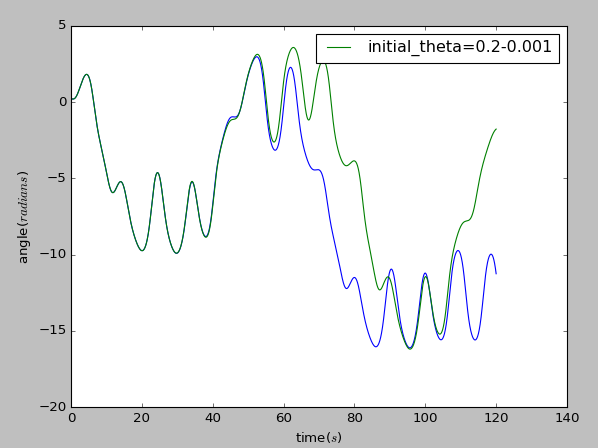
the picture was uploaded to github,if failed loading,click here
2.plot versus
b=chaotic_pendulums()b.pendulum1()b.show_result1()
here is the plot
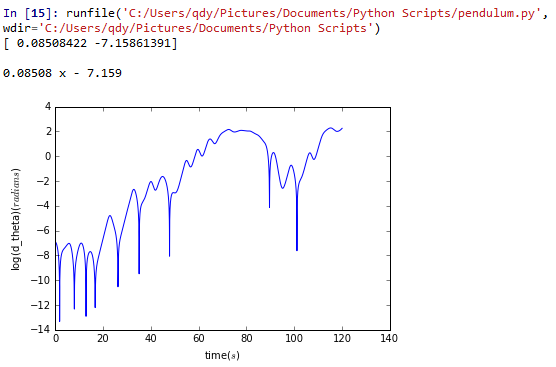
the picture was uploaded to github,if failed loading,click here
3.make a qualitative estimate of the corresponding Lyapunov exponent
c=chaotic_pendulums()c.cal_d_theta()c.show_result2()z=np.polyfit(a.t,a.d_theta,1)p=np.poly1d(z)print(z)print(p)
the linear equation:
thus,the Lyapunov exponent is:
