@OrionPaxxx
2016-12-12T04:51:18.000000Z
字数 4728
阅读 1324
computationalphysics
electric potentials and fields:Laplace's equation
abstract
The partial differential equation is of physicists' great interest for its widely applicaiton in decribing physical systems. Jacobi method and simultaneous over relaxation method are two algrithm that keep a balance of the simplicity for comprehension and accuracy of computation. Here in this passage,we are going to discuss the relation and difference with differnet methods in tackling same problem.
key words:relaxation algorithm,jacobi method,Gauss-seidel method,SOR,Laplace'squation
background
- 1.about electrical field
An electric field is a vector field that associates to each point in space the Coulomb force that would be experienced per unit of electric charge, by an infinitesimal test charge at that point.1 Electric fields converge and diverge at electric charges and can be induced by time-varying magnetic fields. The electric field combines with the magnetic field to form the electromagnetic field
Laplace's equation(in region of space do not contain any elctric charges): - 2.numerical algorithm:relaxation algorithm
1.jacobi method
In numerical linear algebra, the Jacobi method (or Jacobi iterative method) is an algorithm for determining the solutions of a diagonally dominant system of linear equations. Each diagonal element is solved for, and an approximate value is plugged in. The process is then iterated until it converges.
Particularly,in our dicussion in this passage,Jacobi Method can be easily expressed as below:
2.Gauss-seidel method
In numerical linear algebra, the Gauss–Seidel method, also known as the Liebmann method or the method of successive displacement, is an iterative method used to solve a linear system of equations. It is named after the German mathematicians Carl Friedrich Gauss and Philipp Ludwig von Seidel, and is similar to the Jacobi method.
Particularly,in our dicussion in this passage,Gauss-Seidel Method can be easily expressed as below:
3.SOR:Simulatneous over-relaxation:
With this method ,the problem of relatively low convergence rate can be easily solved.Letbe the new value of calculated.Then the change of is represented as:
However,we have seen in our previous examples that this choice of is too conservative.So to speed up convergence we will change the potential by a larger amount calculated according to:
where is a factor that measures how much we "over-relax".Choosing tuekds the Gauss-Seidel method.It turns out that if , the method does bit converge.The best choice of is:
main body
import mathimport matplotlib.pyplot as pltfrom mpl_toolkits.mplot3d import Axes3Dimport numpy as npfrom matplotlib import cmfrom matplotlib.ticker import LinearLocator, FormatStrFormatterclass ef:#初始化创建二维n*n全为0的矩阵,在后面的函数中通过修改矩阵中元素的值来构建不同的电场def __init__(self,alpha=1,n=20):self.n=nself.field=[[0]*(self.n) for i in range(self.n)]#教材figure5.2所示电场def field1(self):self.field[0]=np.linspace(-1,1,self.n)self.field[-1]=np.linspace(-1,1,self.n)for k in range(1,self.n-1):self.field[k][0]=-1self.field[k][-1]=1self.kk=1while(1):self.kk+=1for i in range(1,self.n-1):for j in range(1,self.n-1):self.field[i][j]=(self.field[i+1][j]+self.field[i-1][j]+self.field[i][j+1]+self.field[i][j-1])/4if self.kk>1000:break#教材figure5.4所示电场def field2(self):for i in range(int(self.n/4),int(self.n*3/4)):for j in range(int(self.n/4),int(self.n*3/4)):self.field[i][j]=1self.kk=1while(1):self.kk+=1for i in range(1,self.n-1):for j in range(1,self.n-1):if int(self.n/4)<=i<=int(self.n*3/4) and int(self.n/4)<=j<=int(self.n*3/4):self.field[i][j]=1else:self.field[i][j]=(self.field[i+1][j]+self.field[i-1][j]+self.field[i][j+1]+self.field[i][j-1])/4if self.kk>1000:break#教材figure5.6所示电场def field3(self):for i in range(1,self.n-1):for j in range(1,self.n-1):if j==int(self.n/4) and i>=self.n/4 and i<=self.n*3/4:self.field[i][j]=1elif j==int(self.n*3/4) and i>=self.n/4 and i<=self.n*3/4:self.field[i][j]=-1self.kk=1while(1):self.kk+=1for i in range(1,self.n-1):for j in range(1,self.n-1):if j==int(self.n/4) and i>=self.n/4 and i<=self.n*3/4:self.field[i][j]=1elif j==int(self.n*3/4) and i>=self.n/4 and i<=self.n*3/4:self.field[i][j]=-1else:self.field[i][j]=(self.field[i+1][j]+self.field[i-1][j]+self.field[i][j+1]+self.field[i][j-1])/4if self.kk>5000:breakdef show_field(self):fig = plt.figure()ax = Axes3D(fig)X=np.linspace(-1,1,self.n)Y=np.linspace(-1,1,self.n)X, Y = np.meshgrid(X, Y)Z=self.fieldax.plot_surface(X, Y, Z, rstride=1, cstride=1, cmap=plt.cm.hot)ax.contourf(X, Y, Z, zdir='z', offset=-2, cmap=plt.cm.hot)ax.set_zlim(-2,2)a=ef()a.field2()a.show_field()
a simple example of relaxation algorithm

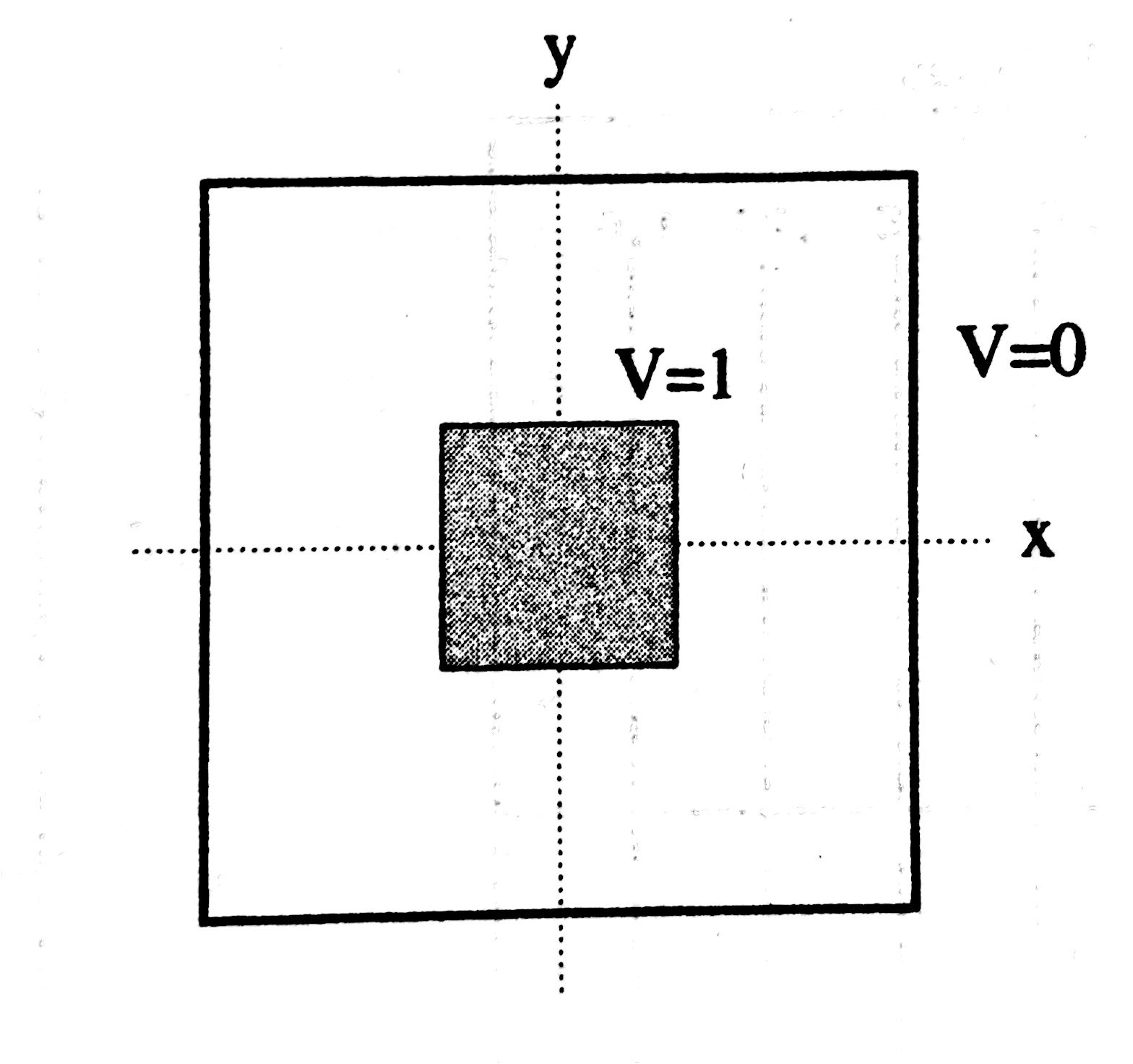
2.Electric potemtial and field inside the prism

3.electric potential of capacitor plates

acknowledgement
- Nicholas J.Giodano's computational physics.
- csdn-皮皮blog
- help of 陆文龙
