@ibilis
2016-11-13T13:51:10.000000Z
字数 4434
阅读 509
第八次作业
计算物理
正文
1.公式推导
2.代码
from math import *from pylab import *# define a function that given amplitude of force, gives angle,avelo and tdef change_amp(F):q = 0.5l = 9.8g = 9.8f = 2/3dt = pi/100theta0 = 0.2omega0 = 0angle = [theta0]avelo = [omega0]t = [0]an=[theta0]av=[omega0]# move the pendulumwhile t[-1] < 3000*pi:avelo_new = avelo[-1] - ((g/l)*sin(angle[-1]) + q*avelo[-1] - F*sin(f*t[-1]))*dtavelo.append(avelo_new)angle_new = angle[-1] + avelo[-1]*dtwhile angle_new > pi:angle_new -= 2*piwhile angle_new < -pi:angle_new += 2*piangle.append(angle_new)t_new = t[-1] + dtt.append(t_new)if t[-1]%(3*pi) <=dt:an.append(angle_new)av.append(avelo_new)return an,avang = change_amp(1.2)[0]ave = change_amp(1.2)[1]scatter(ang,)title('angular velocity versus angle when F=1.2')xlabel('theta(radians)')ylabel('omega(radians/s)')grid(True)show()
from math import *from pylab import *from numpy import *# define a function that given amplitude of force, gives angle,avelo and tdef change_amp(F):# define some constantsq = 0.5l = 9.8g = 9.8f = 2/3+0.00002dt = math.pi/100theta0 = 0.2omega0 = 0angle = [theta0]avelo = [omega0]t = [0]an=[]# move the pendulumwhile t[-1] <= 1200*pi:avelo_new = avelo[-1] - ((g/l)*sin(angle[-1]) + q*avelo[-1] - F*sin(f*t[-1]))*dtavelo.append(avelo_new)angle_new = angle[-1] + avelo[-1]*dtwhile angle_new > pi:angle_new -= 2*piwhile angle_new < -pi:angle_new += 2*piangle.append(angle_new)if t[-1]>=900*pi:if t[-1]%(3*pi)<=dt:an.append(angle_new)t_new = t[-1] + dtt.append(t_new)return anfd1=list(linspace(1.35,1.5,100))fd=[]th=[]for i in fd1:points=change_amp(i)for j in points:fd.append(i)th.append(j)scatter(fd,th,s=10)grid(True)xlim(1.35,1.5)ylim(0,3)title('Bifurcation diagram')xlabel('FD')ylabel('theta(radians)')show()
"""Created on Sat Nov 12 16:21:22 2016@author: dw"""from __future__ import divisionfrom visual import *from math import *q=0.5l=9.8g=9.8f=2/3dt=0.04theta0=0.2omega0=0# add three ceilingsceil1=box(pos=(-20,5,0),size=(5,0.5,2),material=materials.bricks)ceil2=box(pos=(0,5,0),size=(5,0.5,2),material=materials.bricks)ceil3=box(pos=(20,5,0),size=(5,0.5,2),material=materials.bricks)ball1=sphere(pos=(-20+l*sin(theta0),5-l*cos(theta0),0),radius=1,material=materials.emissive,color=color.red)ball2=sphere(pos=(l*sin(theta0),5-l*cos(theta0),0),radius=1,material=materials.emissive,color=color.yellow)ball3=sphere(pos=(20+l*sin(theta0),5-l*cos(theta0),0),radius=1,material=materials.emissive,color=color.green)ball1.omega=omega0ball2.omega=omega0ball3.omega=omega0ball1.theta=theta0ball2.theta=theta0ball3.theta=theta0ball1.t=0ball2.t=0ball3.t=0ball1.F=0ball2.F=0.5ball3.F=1.2string1=curve(pos=[ceil1.pos,ball1.pos],color=color.red)string2=curve(pos=[ceil2.pos,ball2.pos],color=color.yellow)string3=curve(pos=[ceil3.pos,ball3.pos],color=color.green)po1=arrow(pos=ball1.pos,axis=(10*ball1.omega*cos(ball1.theta),10*ball1.omega*sin(ball1.theta),0),color=color.red)po2=arrow(pos=ball2.pos,axis=(10*ball2.omega*cos(ball2.theta),10*ball2.omega*sin(ball2.theta),0),color=color.yellow)po3=arrow(pos=ball3.pos,axis=(10*ball3.omega*cos(ball3.theta),10*ball3.omega*sin(ball3.theta),0),color=color.green)while True:rate(100)ball1.omega=ball1.omega-((g/l)*sin(ball1.theta)+q*ball1.omega-ball1.F*sin(f*ball1.t))*dtball2.omega=ball2.omega-((g/l)*sin(ball2.theta)+q*ball2.omega-ball2.F*sin(f*ball2.t))*dtball3.omega=ball3.omega-((g/l)*sin(ball3.theta)+q*ball3.omega-ball3.F*sin(f*ball3.t))*dtangle1_new=ball1.theta+ball1.omega*dtwhile angle1_new>pi:angle1_new-=2*piwhile angle1_new<-pi:angle1_new+=2*piangle2_new=ball2.theta+ball2.omega*dtwhile angle2_new>pi:angle2_new-=2*piwhile angle2_new<-pi:angle2_new+=2*piangle3_new=ball3.theta+ball3.omega*dtwhile angle3_new>pi:angle3_new-=2*piwhile angle3_new<-pi:angle3_new+=2*piball1.theta=angle1_newball2.theta=angle2_newball3.theta=angle3_newball1.pos=(-20+l*sin(ball1.theta),5-l*cos(ball1.theta),0)ball2.pos=(l*sin(ball2.theta),5-l*cos(ball2.theta),0)ball3.pos=(20+l*sin(ball3.theta),5-l*cos(ball3.theta),0)string1.pos=[ceil1.pos,ball1.pos]string2.pos=[ceil2.pos,ball2.pos]string3.pos=[ceil3.pos,ball3.pos]po1.pos=ball1.pospo2.pos=ball2.pospo3.pos=ball3.pospo1.axis=(10*ball1.omega*cos(ball1.theta),10*ball1.omega*sin(ball1.theta),0)po2.axis=(10*ball2.omega*cos(ball2.theta),10*ball2.omega*sin(ball2.theta),0)po3.axis=(10*ball3.omega*cos(ball3.theta),10*ball3.omega*sin(ball3.theta),0)ball1.t=ball1.t+dtball2.t=ball2.t+dtball3.t=ball3.t+dt
3结果
1.


2.


3.用Vpython画出动图
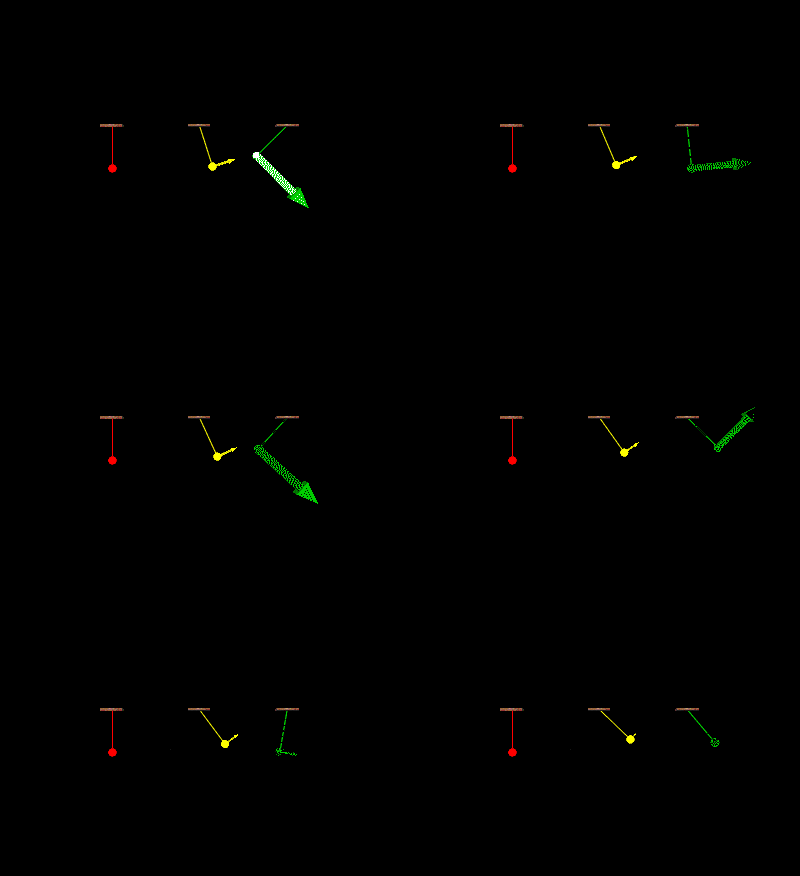
2结论
参数的微小改变,对混沌现象的产生有着较大的影响
