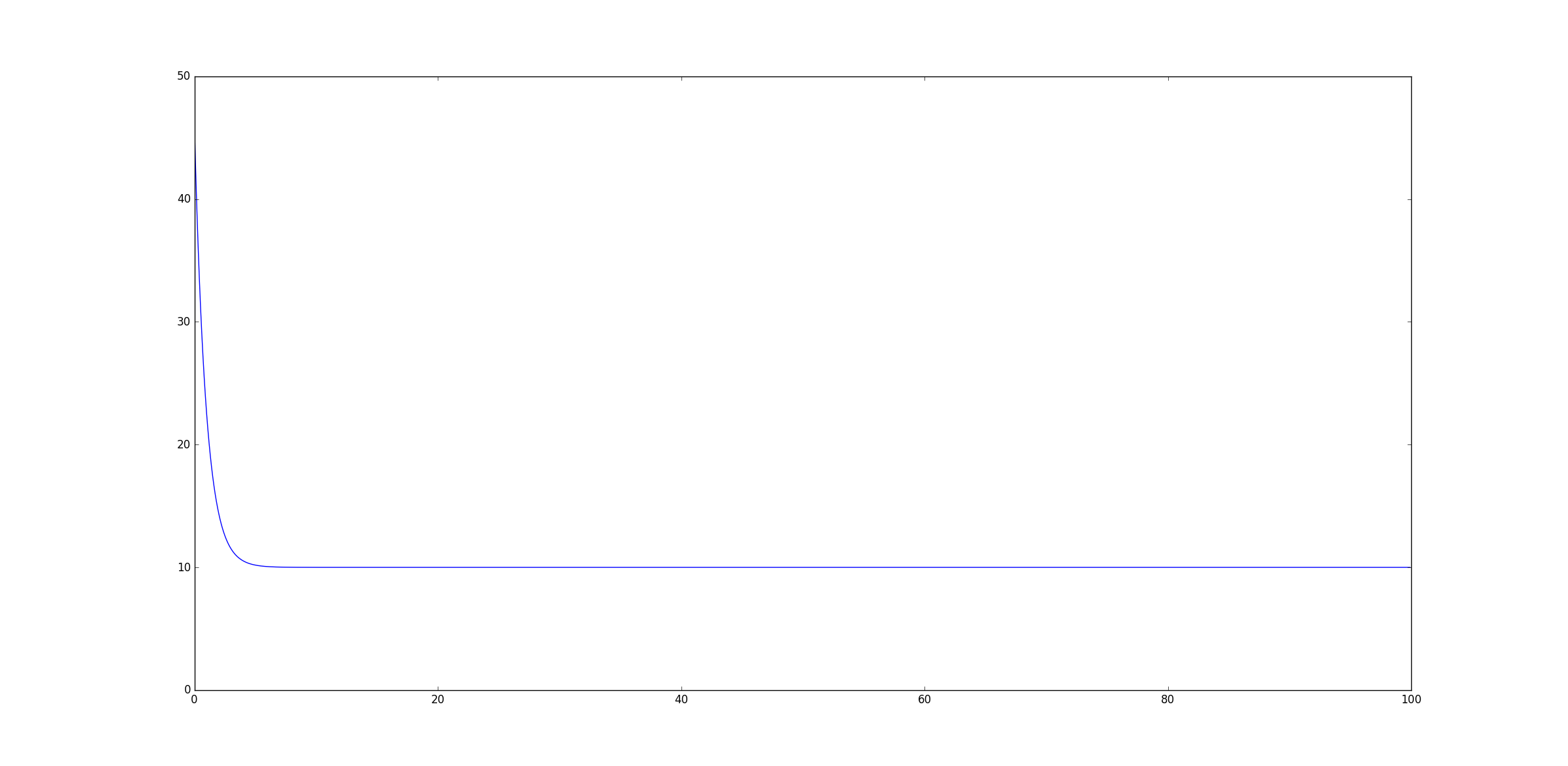
It is often the case that the frictional force on an object will increase as the object moves faster. A fortunate example of this is a parachutist; the role of the parachute is to produce a frictional force due to air drag , which is larger than would normally be the case without the parachute. The physics of air drag will be discussed in more detail in the next chapter. Here we consider a very simple example in which the frictional force depends on the velocity. Assume that the velocity of an object obeys an equation of the form where a and b are constants. You could think of a as coming from an applied force such as gravity, while arises from friction. Note that the frictional force is negative(we assume that b > 0 ), so that it opposes the motion, and that it increases in magnitude as the velocity increases. Use the Euler method to solve the equation for v as a function of time.