@BertramLee
2016-06-12T05:24:49.000000Z
字数 1832
阅读 1086
计算物理第五次作业
物基一班 李云龙 2013301020065
背景
第一章习题1.5
Consider again a decay problem with two types of nuclei A and B, but now suppose that nuclei of type A decay into ones of type B, while nuclei of type B decay into ones of type A. Strictly speaking, this is not a "decay" process, since it is possible for the type B nuclei to turn back into type A nuclei. A better analogy would be a resonance in which a system can tunnel or move back and forth between two states A and B which have equal energies. The corresponding rate equations are
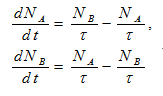
where for simplicity we have assumed that the two types of decay are characterized by the same time constant, tau. Solve this system of equation for the numbers of nuclei, NA and NB, as functions of time. Consider different initial conditions, such as NA=100, NB=0, etc, and take tau=1s. Show that your numerical results are consistent with the idea that the system reaches a steady state in which NA and NB are constant. In such a steady state, the time derivatives dNA/dt and dNB/dt should vanish.
摘要
本文通过欧拉方法来对计算物理第一章习题1.5进行分析。
正文
- 理论推导
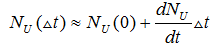
此题为两体衰变问题,根据欧拉方法,首先对衰变率取零时泰勒展开:

当衰变时间变化率非常小的时候,忽略高阶项,保留一阶项:
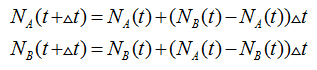
结合题目所给两体衰变关系式,我们可以推得以下递推关系式:
- 实验计算分析
实验计算代码如下链接:chapter-one-1.5-code
题目要求我们计算不同的初始情况下A和B的衰变情况,所以我们可以选择取三组不同的情况来进行结果的相关讨论:
1.取NA=100,NB=0
The initial number of A: 100
The initial number of B: 0
The initial number of time: 0
The time step is: 0.002
计算得到图像结果如下:
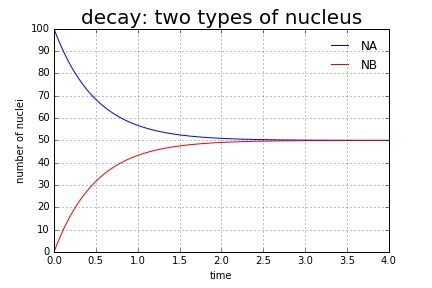
由计算结果可知,最终系统达到一个稳定的平衡状态,平衡时为初始值两者粒子数和的一半。
2.取NA=100,NB=30
The initial number of A: 100
The initial number of B: 30
The initial number of time: 0
The time step is: 0.002
计算得到图像结果如下:
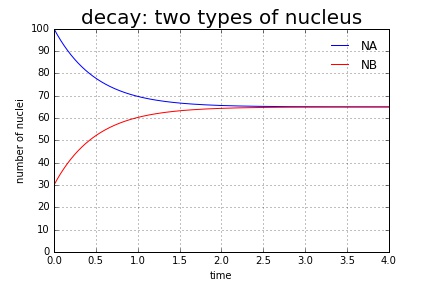
由计算结果可知,最终系统达到一个稳定的平衡状态,平衡时为初始值两者粒子数和的一半。
3.取NA=80,NB=40
The initial number of A: 80
The initial number of B: 40
The initial number of time: 0
The time step is: 0.002
计算得到图像结果如下:
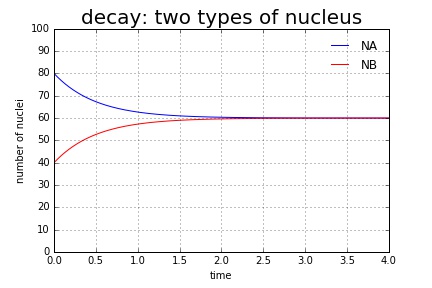
由计算结果可知,最终系统达到一个稳定的平衡状态,平衡时为初始值两者粒子数和的一半。 - 结果分析
根据三组计算结果,可以分析得到,当NA、NA的初始值为一确定值时,系统随时间推移最终都达到稳定的平衡态,平衡时为初始值两者粒子数和的一半,并且NA,NB随时间的变化率消失不见,或者说系统达到稳定的动态平衡状态。也即为题目中所描述的那样:Show that your numerical results are consistent with the idea that the system reaches a steady state in which NA and NB are constant. In such a steady state, the time derivatives dNA/dt and dNB/dt should vanish.
